
available 24/7
Free Consultation
Many drivers assume there is a legal THC limit for driving similar to the 0.08 BAC limit for alcohol. In reality, the answer is much more complicated. There is no universal federal standard, and states use different approaches when prosecuting marijuana-related DUI offenses.
Arizona has some of the country’s strictest marijuana DUI laws, and being charged with one is frightening and confusing — especially when the rules around THC are so unclear.
But a charge is not a conviction, and being arrested does not mean the state can prove its case.
If you have been arrested for a marijuana DUI, contact Rosenstein Law Group immediately.
Call (480) 248-7666 for a free consultation with an experienced Arizona DUI defense attorney.
No.
There is no federal THC limit for drivers operating personal vehicles on public roads.
Because DUI laws are primarily governed by state law, each state establishes its own rules regarding marijuana impairment and driving under the influence of drugs.
As a result, state-by-state THC laws vary considerably.
States generally use one of three approaches.
Some states establish a per se THC limit measured in nanograms per milliliter (ng/mL) of active THC in the bloodstream.
For example:
In these states, prosecutors may rely heavily on a THC blood test showing a blood THC level above the statutory per se threshold.
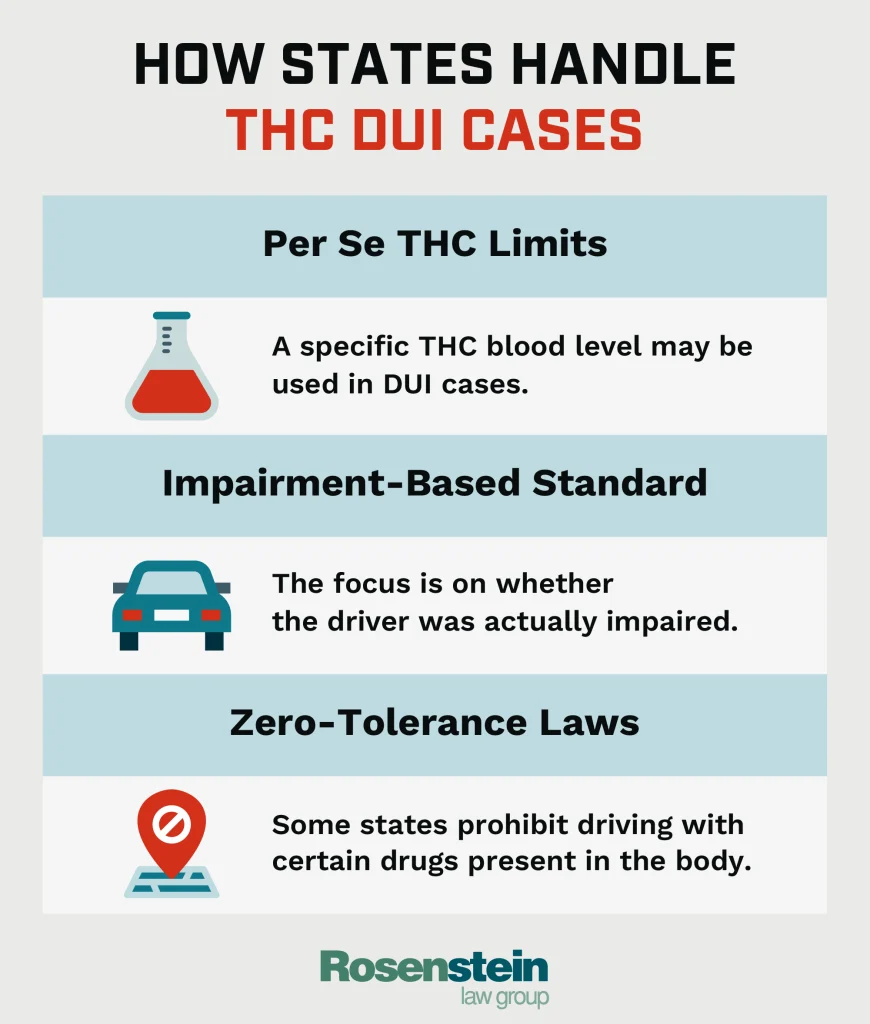
Other states use an impairment-based standard instead of a numerical THC legal limit driving rule.
Under this approach, prosecutors must prove the driver’s marijuana impairment actually affected the ability to safely operate a vehicle.
Evidence may include:
Some jurisdictions have adopted versions of zero-tolerance THC laws that prohibit driving with certain drugs or compounds present in the body.
However, the scope of these laws varies by state, making it important to review the applicable statutes rather than assume that every zero-tolerance state follows the same rules.
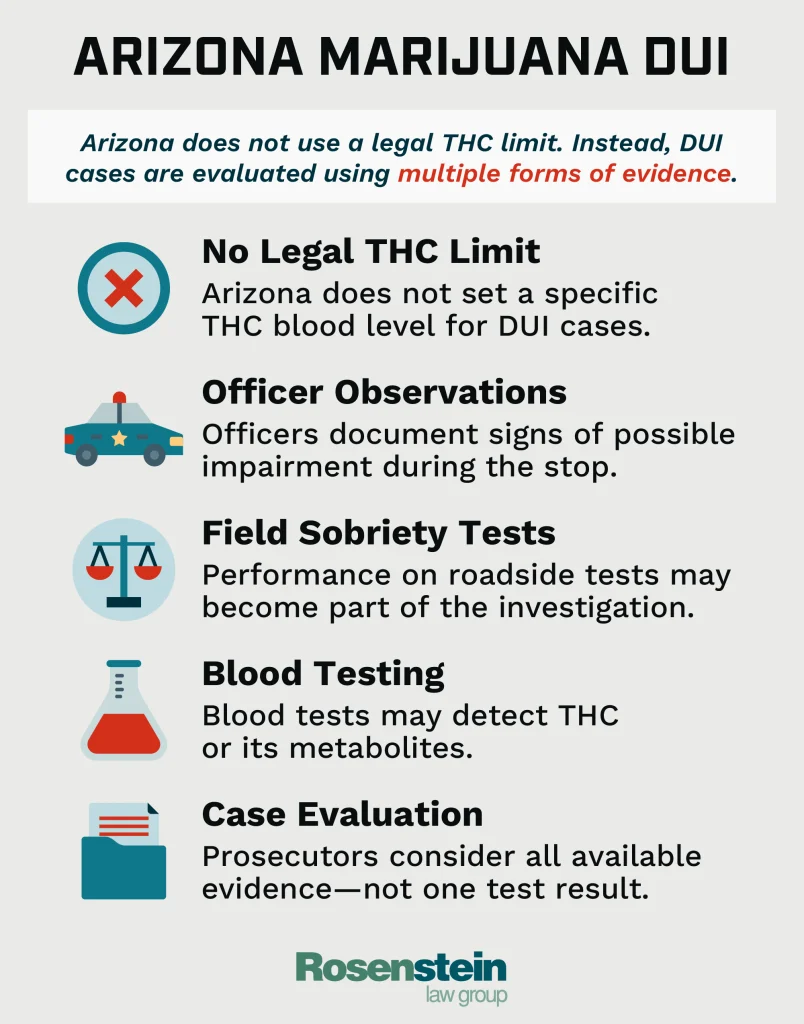
Arizona marijuana DUI law does not establish a numerical per se THC limit driving standard comparable to the 0.08% BAC limit used for alcohol.
Instead, Arizona Revised Statutes § 28-1381 creates multiple ways prosecutors may pursue a marijuana DUI charge.
Under A.R.S. § 28-1381(A)(1), it is unlawful to drive or be in actual physical control of a vehicle while impaired to the slightest degree by any drug, liquor, vapors, or combination thereof.
Arizona Revised Statutes § 28-1381(A)(3) separately addresses driving with certain impairing drugs identified in Arizona law present in the body.
Historically, Arizona courts interpreted this provision broadly. More recently, Arizona appellate decisions have clarified how active THC and THC metabolites are treated under the statute. As a result, these cases often involve detailed legal and scientific analysis rather than a simple numerical threshold.
Because Arizona does not recognize a per se THC limit measured in nanograms per milliliter, prosecutors rely on the applicable statute together with the evidence collected during the investigation.
Without a numerical THC legal limit for driving standards, law enforcement relies on multiple forms of evidence in a drug-related DUI investigation.
A marijuana DUI investigation may include:
Unlike alcohol breath testing, there is currently no widely accepted roadside device that measures THC impairment with the same level of certainty.
A blood draw may detect:
However, a THC blood test cannot determine precisely when marijuana was consumed or whether a person was actually impaired while driving.
THC stays in the blood differently than alcohol remains in the body, and the THC detection window varies depending on numerous factors.
For example, a chronic marijuana user may retain detectable compounds longer than an occasional user. Likewise, tolerance to THC varies from person to person, making marijuana impairment much more difficult to measure using a single blood THC level.
Arizona medical marijuana laws do not create immunity from DUI prosecution.
Even if you possess a valid medical marijuana card or lawfully use recreational marijuana under Proposition 207, you may still face criminal charges if prosecutors believe you violated Arizona DUI law.
The legality of possessing marijuana is separate from whether law enforcement believes you were driving under the influence of marijuana.
A DUI conviction involving marijuana may carry serious consequences, including:
The specific DUI penalties depend on the facts of the case, prior convictions, and the applicable Arizona statutes.
You do not have to navigate this alone. Marijuana DUI cases often involve complicated questions of toxicology, police procedures, blood testing, and Arizona law — the kind of issues that are difficult to face without experienced help.
An experienced Arizona DUI attorney at Rosenstein Law Group can:
Because Arizona does not rely on a simple legal THC limit for driving, every piece of evidence should be carefully examined before deciding how to proceed.
If you have been arrested for a marijuana DUI, do not assume the prosecution can prove its case simply because THC was detected in your system. Arizona does not use the same per se numerical THC standards found in some other states, and every DUI case depends on its own facts and evidence.
Rosenstein Law Group provides strategic, high-level criminal defense representation for individuals facing marijuana DUI charges throughout Arizona.
Call (480) 248-7666 today for a free consultation with an experienced Arizona DUI defense attorney.