
available 24/7
Free Consultation
A marijuana DUI investigation looks very different from an alcohol DUI investigation. Unlike alcohol, no roadside device can accurately measure a driver’s level of marijuana impairment.
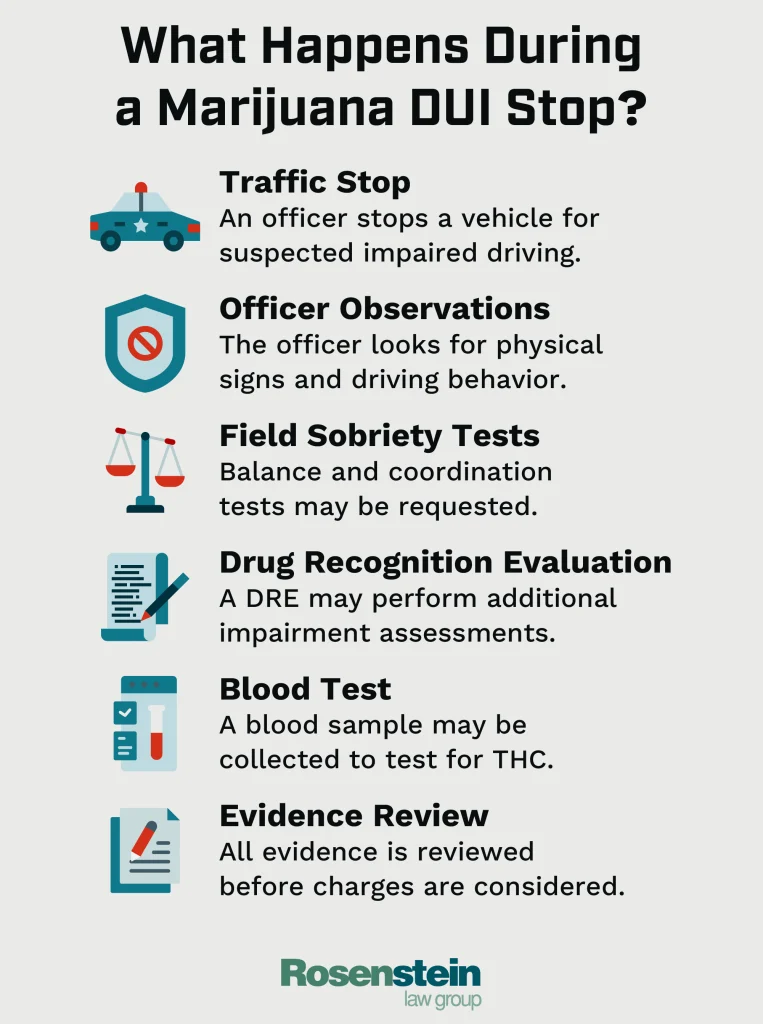
Instead, law enforcement officers rely on a combination of observations, field sobriety tests, drug recognition evaluations, and chemical testing when they suspect someone is driving under the influence of marijuana.
If you were arrested for a marijuana DUI, the evidence against you should be carefully examined before you make any decisions about your case.
Call Rosenstein Law Group at (480) 248-7666 for a free consultation with an experienced Arizona DUI defense attorney.
There is no single DUI test for weed that can definitively prove a driver was impaired by marijuana.
Instead, police build marijuana DUI cases by gathering different types of evidence throughout a traffic stop. An officer may consider how a person was driving, their physical appearance, their performance on field sobriety tests, statements they make during the investigation, and the results of chemical testing.
Arizona Revised Statutes § 28-1381 governs DUI offenses involving alcohol and drugs, including marijuana. Arizona’s drugged driving laws previously took a zero-tolerance approach that allowed prosecution based on any detectable marijuana metabolite.
However, the Arizona Supreme Court’s decision in State ex rel. Montgomery v. Harris (Shilgevorkyan) clarified that the law applies to active THC rather than non-impairing metabolites alone. Even so, prosecutors continue to aggressively pursue marijuana DUI cases using multiple forms of evidence gathered during an investigation.
A marijuana DUI investigation usually begins with a routine traffic stop.
An officer may claim they observed behavior suggesting impaired driving, such as:
Once the vehicle is stopped, the officer begins looking for additional signs that could support a DUI investigation.
These observations may include:
These observations alone do not prove impairment, but they often lead officers to conduct additional testing.
Field sobriety tests are one of the primary tools officers use during marijuana DUI investigations.
The three Standardized Field Sobriety Tests (SFSTs) recognized by the National Highway Traffic Safety Administration (NHTSA) are the Horizontal Gaze Nystagmus (HGN) test, the Walk-and-Turn test, and the One-Leg Stand test. These standardized field sobriety tests were developed and validated by NHTSA to detect alcohol impairment, not marijuana impairment.
The HGN test measures involuntary eye jerking known as nystagmus. Because marijuana generally does not cause nystagmus, the HGN test is often of limited value when evaluating suspected marijuana impairment.
The Walk-and-Turn and One-Leg Stand tests are intended to assess balance, coordination, divided attention, and the ability to follow instructions.
However, many factors unrelated to marijuana impairment may affect performance, including:
Because of these limitations, field sobriety tests should be challenged in marijuana DUI cases.
If an officer suspects drug impairment, law enforcement may request assistance from a Drug Recognition Expert, commonly called a DRE.
A Drug Recognition Expert is a law enforcement officer who receives specialized training to identify drug impairment using a standardized 12-step evaluation protocol originally developed by the Los Angeles Police Department and later adopted by NHTSA.
During the evaluation, the DRE may examine:
Although prosecutors frequently rely on DRE testimony, these evaluations are based largely on an officer’s subjective observations rather than objective scientific measurements.
DRE testimony has also been challenged in courts across the country because the protocol lacks sufficient scientific validation to identify impairment caused by a specific drug reliably.
An experienced defense attorney will challenge both the methodology and the conclusions reached during the DRE evaluation.
Unlike alcohol DUI cases, marijuana DUI investigations most commonly rely on a blood test rather than a breath test.
After an arrest, law enforcement may obtain a blood sample to determine whether THC (delta-9-tetrahydrocannabinol) or its metabolites are present in the driver’s system.
Blood testing is the most common chemical test used in marijuana DUI cases because it can detect both active THC and marijuana metabolites. However, a blood test cannot determine exactly when marijuana was consumed or whether the driver was actually impaired while driving.
Unlike alcohol, Arizona does not establish a per se legal THC concentration similar to the 0.08% BAC limit used in alcohol DUI cases. Instead, blood test results become just one piece of the evidence prosecutors use when attempting to prove a marijuana DUI.
No.
Traditional breath test devices measure alcohol, not marijuana.
An alcohol breathalyzer estimates blood alcohol content by measuring ethanol in a person’s breath. It cannot detect THC or determine whether someone was under the influence of marijuana.
Although researchers continue developing new technology, there is currently no widely accepted roadside breath test that accurately measures marijuana impairment in the same way alcohol breath testing measures BAC.
In some situations, officers may request a urine sample during a drug investigation.
A urine test can detect marijuana metabolites that remain in the body after cannabis use. However, those metabolites may remain detectable long after any actual impairment has ended.
For that reason, urine testing generally provides evidence of marijuana use rather than whether someone was impaired by marijuana while driving.
Blood testing is more commonly used in Arizona marijuana DUI investigations.
Marijuana DUI cases often involve scientific and legal disputes because no single test can conclusively establish impairment.
Unlike alcohol, THC affects different people differently based on factors such as:
As a result, prosecutors frequently rely on a combination of officer observations, field sobriety testing, drug recognition evaluations, and chemical testing rather than a single objective measurement.
Each type of evidence has potential weaknesses that may become important during a criminal defense case.
An experienced DUI defense attorney will evaluate every stage of the investigation to determine whether the evidence supports the charges.
Depending on the facts, potential defenses may include:
Every marijuana DUI case is different, and an effective defense depends on the specific facts surrounding the arrest.
There is no single DUI weed test that proves a driver was impaired by marijuana. Instead, Arizona law enforcement relies on field sobriety tests, drug recognition evaluations, blood testing, and other evidence when investigating suspected marijuana DUI offenses.
If you have been arrested or charged with driving under the influence of marijuana, do not assume the evidence against you is conclusive. Rosenstein Law Group provides strategic DUI defense representation for clients facing marijuana DUI charges throughout Arizona.
Call Rosenstein Law Group at (480) 248-7666 today for a free consultation with an experienced marijuana DUI defense attorney.