
available 24/7
Free Consultation
In Arizona, no statute explicitly says riding a horse while intoxicated is sufficient for a DUI charge. Arizona DUI law focuses on whether a person was driving or in actual physical control of a vehicle while impaired, so the issue is whether a horse is a vehicle.
However, that does not mean riding a horse drunk is safe or risk-free. A person riding a horse under the influence in Scottsdale, Phoenix, or elsewhere in Maricopa County could still face an arrest, criminal charges, disorderly conduct allegations, animal cruelty issues, or other penalties depending on what happened.
If you were arrested or charged after riding a horse while intoxicated, call (480) 248-7666 to speak with a Rosenstein Law Group DUI lawyer immediately.
Arizona DUI law makes it unlawful to drive or be in actual physical control of a vehicle while under the influence of alcohol, drugs, or any other impairing substance. Under Arizona law, a vehicle is a device in, on, or by which a person or property may be transported or drawn on a public highway, with certain exceptions.
That means Arizona DUI charges can involve more than traditional drunk driving in a car. A DUI arrest may involve a truck, motorcycle, off-road vehicle, golf cart, or other vehicle, depending on the facts.
A horse does not fit neatly within the definition of a vehicle, raising a legal question in any alleged horse DUI case. A horse is an animal that moves on its own — not a device a person is transported in, on, or by — so it is hard to square with what the statute calls a vehicle.
Notably, no Arizona appellate court has squarely decided whether riding a horse can support a DUI under A.R.S. § 28-1381. Because the courts have not settled the question, the outcome of any horse DUI case would likely turn on how a prosecutor and judge apply the existing vehicle definition to the specific facts.
However, a person may still be arrested for public safety even if DUI isn’t the most applicable charge. Police may see an intoxicated person riding a horse in traffic or on a public road and decide the situation creates danger.
Actual physical control is a major issue in Arizona DUI law. A person does not have to be actively driving to face an Arizona DUI charge if the state can prove actual physical control of a vehicle.
In a normal DUI case, physical control might involve where the person was, whether the engine was on, where the keys were, whether the vehicle could move, and whether the person posed a danger. Actual physical control usually turns on whether the person had present or imminent control over a vehicle.
A horse DUI case is different because the “vehicle” issue comes first. If the horse is not a vehicle under Arizona law, then actual physical control of the horse may not satisfy A.R.S. § 28-1381.
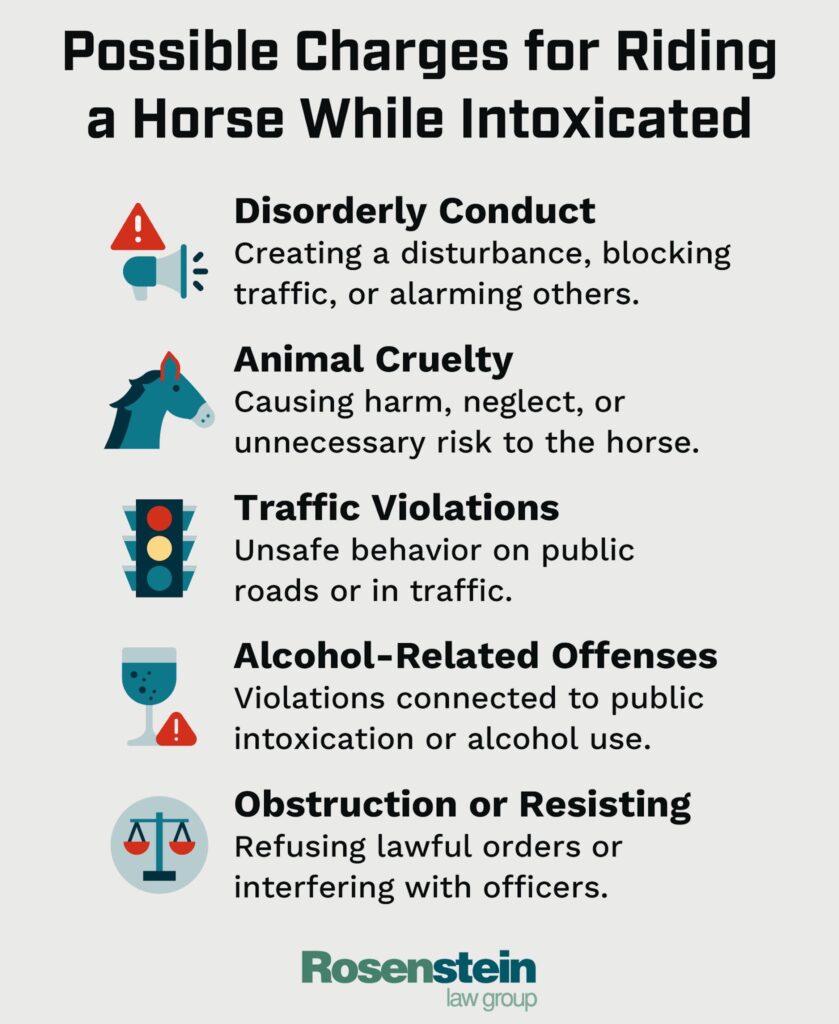
Even if a DUI on a horse is legally questionable, an intoxicated rider could still be arrested in Arizona.
Police do not always resolve statutory interpretation on the roadside. If an officer believes a drunk person riding a horse is creating danger, blocking traffic, refusing orders, alarming the public, or mistreating the horse, the officer may arrest the person and let prosecutors sort out the charges.
Possible charges may include:
One charge that often comes up in these conversations is public intoxication, but Arizona does not have a public intoxication charge. Under A.R.S. § 36-2031, the state treats public intoxication as a health issue rather than a crime, and cities and towns cannot make being drunk in public an offense on its own.
That is different from some other states, and it is an important distinction. It does not mean an intoxicated rider is in the clear, though, because the conduct surrounding the intoxication — not the intoxication itself — is what leads to charges like disorderly conduct or animal cruelty.
For example, a person riding a horse while intoxicated could face animal cruelty allegations if prosecutors claim the horse was injured, recklessly mistreated, neglected, or placed at serious risk.
Moreover, if an intoxicated person is yelling, fighting, blocking traffic, refusing lawful orders, or creating a disturbance, prosecutors may consider disorderly conduct or other charges.
The penalties depend on the charge. If a person is charged with an Arizona DUI, the case may involve jail time, fines, alcohol screening, license consequences, ignition interlock requirements, probation, and a permanent criminal record.
A first DUI in Arizona is generally a class 1 misdemeanor. The statute includes mandatory jail time and fines after conviction.
If prosecutors do not pursue a DUI charge, other charges still carry penalties. Disorderly conduct is a class 1 misdemeanor in most cases. Animal cruelty can be a misdemeanor or felony, depending on the alleged conduct. Those charges can still create fines, probation, jail time, and long-term consequences that result from having a criminal conviction on your record.
The penalties can increase if there are prior convictions, injuries, allegations of resisting, property damage, a high BAC, or other aggravating factors. That is why an arrest after horseback riding should be taken seriously.
If you were arrested after riding a horse while intoxicated, do not assume the case is funny, harmless, or impossible to prosecute. A weak DUI charge can still cause real problems if it is not properly challenged.
Important steps include:
The defense may involve statutory interpretation, lack of vehicle evidence, weak allegations of actual physical control, unreliable BAC testing, lack of impairment, unlawful stop, officer error, or overcharging.
Our team can examine whether A.R.S. § 28-1381 applies at all, whether the horse can legally be treated as a vehicle, and whether prosecutors can prove actual physical control. We also review BAC evidence, officer reports, body camera footage, witness statements, and the facts leading to the arrest.
If the state files disorderly conduct, animal cruelty, or other criminal charges instead of DUI, we can build a defense around the specific allegations. The goal is to protect your record, reduce risk, and push back against charges that do not fit the law.
Regardless, an intoxicated person riding a horse can face arrest, criminal charges, penalties, fines, jail time, animal cruelty allegations, or disorderly conduct accusations. The sooner a DUI lawyer gets involved, the sooner the defense can challenge the state’s theory.
If you were charged after horseback riding in Scottsdale, Phoenix, or anywhere in Maricopa County, contact Rosenstein Law Group at (480) 248-7666 for a free consultation.