
available 24/7
Free Consultation
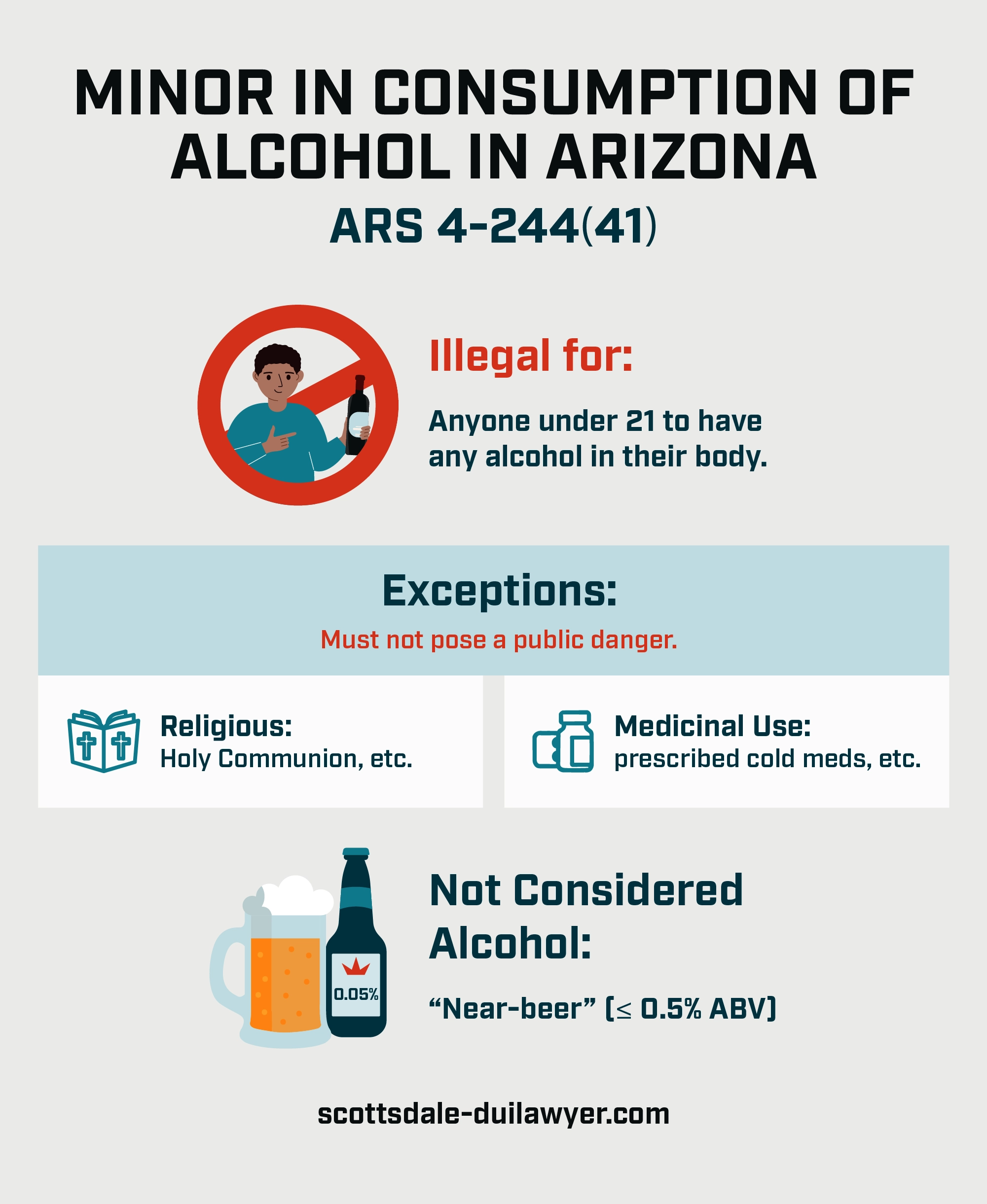
Under ARS 4-244(41), a person younger than 21 can be charged with having spirituous liquor in their body. This offense is commonly called minor in consumption, or MIC. With specific religious and medicinal defenses, Arizona prohibits this conduct even when the person was not driving, was not publicly intoxicated, and had not reached a blood alcohol concentration of 0.08%.
A minor in consumption conviction can have serious consequences for a young person and their family. Understanding what the law covers, which charge appears on the citation, and what evidence supports it is the first step toward responding.
The subsection on the citation matters. Having alcohol in your body, possessing alcohol, and driving after drinking are separate offenses with different consequences. A citation that says only “underage drinking” does not tell you everything you need to know about the case.
If you or your child received an alcohol citation, call Rosenstein Law Group at (480) 248-7666 or contact us for a free consultation. An attorney can review the exact charge, the evidence, and the next court date.
For a charge under ARS 4-244(41), the prosecution must establish that the accused was under 21 and had spirituous liquor in their body. The statute does not require proof that the person was visibly impaired or had reached the adult DUI threshold.
Being at a party where others were drinking does not, by itself, establish those facts. The evidence might include observations, statements, witnesses, or testing. Conversely, the absence of a breath test does not automatically defeat the charge. A defense review considers the admissible evidence as a whole.
These classifications come from ARS 4-246. More than one allegation can arise from the same incident. A case involving a vehicle also requires a separate review of Arizona underage DUI law.
Arizona’s definition in ARS 4-101 is broad. It includes familiar alcoholic drinks and mixtures, including:
The definition is not limited to liquor served in a shot glass. Mixing a spirit with juice or another ingredient does not take it outside the law. Food and medicinal products require closer analysis: the statute excludes certain federally qualified nonbeverage products, and separate exemptions can apply under ARS 4-226.
Some products sold as “nonalcoholic,” “near beer,” or low-alcohol beverages contain small amounts of alcohol. A label or an alcohol concentration of 0.5% or less should not be treated as an automatic defense. Arizona’s definition separately lists beer and malt beverages as well as beverages above the 0.5% threshold; it does not expressly exempt every beverage at or below that percentage.
If the allegation involves such a product, preserve the container, ingredient information, receipt, and any photograph showing what was consumed. The product’s actual classification, the source of the alcohol, and the other evidence must be reviewed.
For example, a group found with containers labeled “nonalcoholic” presents different evidence from a group also found with open ordinary beer or spirits. A trace test result alone does not identify which beverage was consumed, and another person’s open container does not automatically prove that everyone present possessed or consumed it.
For an adult sentenced for a first class 2 misdemeanor under ARS 4-244(41), the general maximum penalties are four months in jail and a $750 base fine. Surcharges and other court assessments can increase the amount owed. These limits appear in ARS 13-707 and ARS 13-802.
Those are maximums, not a prediction of the sentence. Under ARS 13-902, the ordinary probation maximum for a class 2 misdemeanor is two years, subject to statutory exceptions or extensions.
Sentencing and available resolutions can depend on the person’s age, prior alcohol offenses or other criminal history, the circumstances of consumption, and any additional conduct. Certain repeat misdemeanor convictions can trigger enhanced sentencing under ARS 13-707. Cases involving someone younger than 18 may follow juvenile procedures rather than adult misdemeanor sentencing.
Alcohol education or treatment, probation, and community service may be considered in an appropriate case. There is no guaranteed first-offense sentence of one year of probation, and a first offense does not guarantee that jail will be avoided.
Some courts or prosecutors offer diversion or deferred prosecution. These programs generally require a person to complete specified conditions before the case can be dismissed. The written agreement controls: confirm the required classes, costs, completion deadlines, and consequences of failing to complete the program. A successful dismissal is different from a conviction followed by completion of probation.
An incident involving DUI, assault, or another offense must be evaluated beyond the MIC citation. Those charges can carry their own penalties and affect negotiations or sentencing. A low alcohol level or lack of a prior record does not erase a separate offense.
Do not assume every MIC conviction automatically suspends a driver’s license. License consequences must be tied to the applicable statute and charge. For example, ARS 4-246 contains a specific license provision for certain violations of subsection (9) committed by someone under 18; that provision does not make suspension automatic in every subsection (41) case.
ARS 4-244(41) recognizes two express defenses:
These are specific defenses, not general permission for underage drinking at home or with parental approval. The religious defense is also addressed in ARS 4-249.
Other issues worth examining include:
A lack of admissions, corroborating witnesses, or reliable testing may expose a gap in the evidence, but the absence of a portable breath device alone does not require dismissal. Police can rely on other admissible evidence. An inaccurate or inconsistent police report should be compared with recordings, witness accounts, and testing records rather than accepted at face value.
Likewise, a missing warning or procedural error does not automatically erase every piece of evidence. Counsel must connect the issue to a legally available defense or remedy.
Keep the citation and identify the court, charge, and required appearance date. There is no single statewide “30-day deadline” that replaces the date on your paperwork. Photograph relevant documents, preserve messages and receipts, and write down witness names while the events are fresh.
Before accepting a plea, ask whether diversion or deferred prosecution is available in that court and case. Review any offer alongside a separate MVD action or additional charge; dismissal of one allegation should not be assumed to resolve everything from the incident.
The practical distinction is between an arrest, a pending charge, a conviction, and a dismissal. School conduct rules and application questions may treat them differently. A criminal record can matter for employment, college admission, scholarships, housing, or campus discipline, but an MIC charge does not establish that any of these opportunities will automatically be lost.
Scholarship conditions, institutional financial aid rules, and federal aid eligibility are different questions. Check the actual program or school policy instead of assuming every alcohol misdemeanor disqualifies a student. Keep records of the final disposition so that later applications and background checks can be addressed accurately.
Bring the complete citation and any court notices to your consultation, including pages that appear to concern a separate alcohol or driving offense. You can learn about Craig J. Rosenstein and contact Rosenstein Law Group to discuss the evidence, available resolutions, and consequences before your next appearance.