
available 24/7
Free Consultation
Arizona law prohibits drivers and passengers from having open alcohol containers in the passenger area of a vehicle while on public roads.
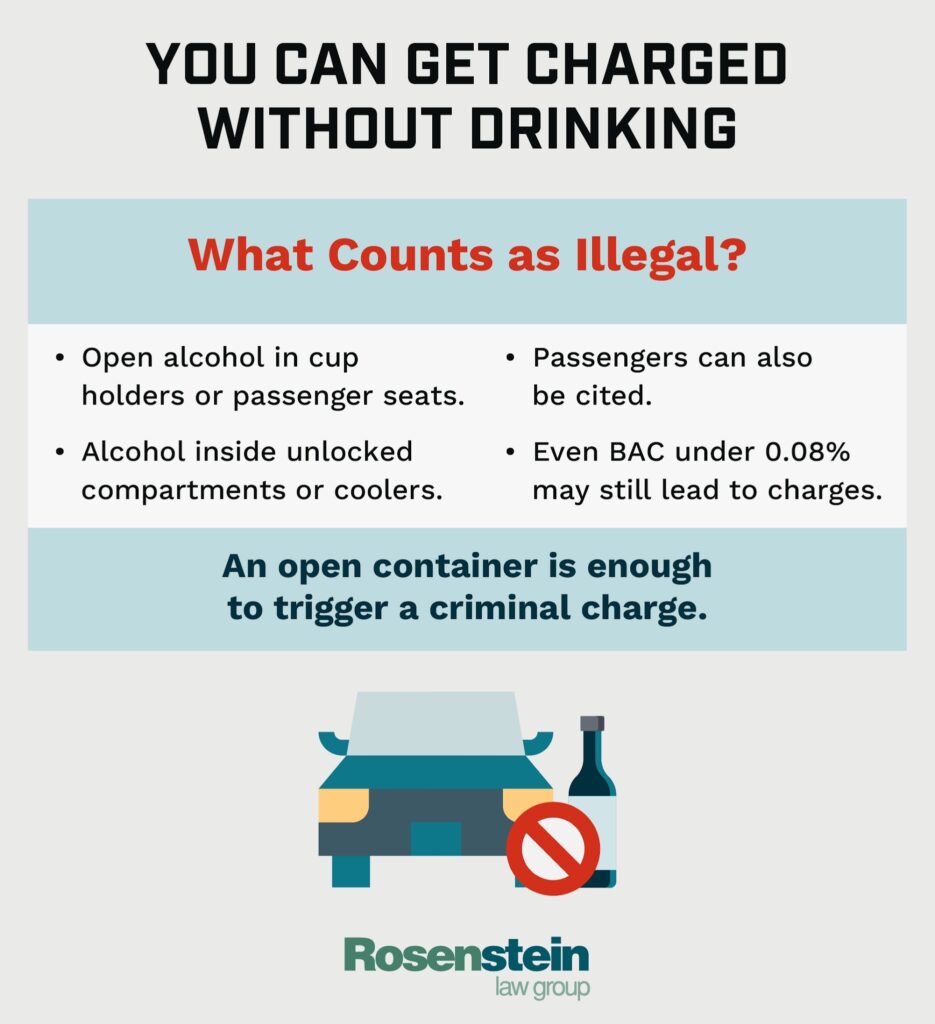
Even if you are driving with a blood alcohol content that is under the presumed legal limit of impairment of 0.08%, possessing or consuming alcohol while in the passenger compartment of a vehicle is an offense in itself that can affect anyone in the vehicle.
If you were pulled over anywhere in Arizona, an open container in your car can put you in the prosecutor’s crosshairs.
This means that you could find yourself facing prosecution for an alcohol offense even if you haven’t taken a single sip of liquor.
In this article, we cover the fundamentals of Arizona’s open container law, including key definitions, its relationship to Arizona DUI laws, and possible penalties if you are convicted of having an open container in your car.
For a first-offense open-container violation, a Rosenstein Law Group attorney may be able to help reduce your penalties or negotiate a resolution to avoid jail and minimize potential fines.
And perhaps most importantly, hiring one of our DUI defense attorneys means you have an experienced professional handling the legal complexities so you can make informed decisions about your case.
If you have been charged with an Arizona open container law violation, call us at 480-248-7666 to schedule a free consultation with an experienced criminal defense attorney, or use our online contact form.
Arizona Revised Statutes (ARS) Section 4-251 is the state’s primary open container law. This law makes it unlawful for any person to consume alcohol or possess an open container of alcohol inside the passenger compartment of a motor vehicle on any public highway or its right-of-way.
The statute applies to vehicles in motion or even parked on public roads. If you are convicted of a violation, it is a Class 2 misdemeanor.
Another statute that complements ARS 4-251 is ARS 4-244(34). This law prohibits anyone under age 21 from drinking while driving.
Under ARS 4-251(D), an “open container” means any bottle, can, jar, or other receptacle containing a spirituous liquor that has been opened, has a broken seal, or from which some contents have been removed.
In other words, if the original seal is not fully intact, the container is open. Examples of open containers include:
You do not need to be actively drinking for it to count as an open container.
Examples of what is not an open container under Arizona law include an unopened, factory-sealed bottle or can of alcohol. These are legal to carry in a passenger compartment of a vehicle, although you must still transport them legally.
The key is that these items must actually contain spirituous liquor at the time the officer observes them. In Arizona, “spirituous liquor” is broad — it covers any alcoholic beverage, including beer and wine, not just distilled spirits.
So if you have an empty beer or wine bottle in your car that is dry inside, it is not an “open container” in the legal sense, despite being an open container in the everyday sense, because it currently does not hold any alcohol.
Under A.R.S. § 4-251(D)(1), a motor vehicle means any self-propelled vehicle. The only carve-out is for vehicles that operate exclusively on rails or on water, so virtually any car, truck, SUV, or motorcycle you would drive on the road counts.
Under Arizona’s open container law, a public highway, or a right-of-way of a public highway, includes any street open to the public for vehicular travel that a town, city, county, the state of Arizona, or the federal government maintains.
This means that, aside from private roads, any public street you can drive on is likely to be a public highway for open container law purposes.
The passenger compartment of a motor vehicle is any area of the vehicle that is designed for people to sit, including the driver and passenger seats. In a typical private car, neither driver nor passenger may legally have an open container. The law applies to everyone in the passenger area, not just the driver.
The passenger compartment includes common areas like cup holders, door pockets, seat pockets, an unlocked glove compartment, a center console, and even an unlocked cooler within reach of a passenger. If an open container is accessible to anyone in these seating areas, then it violates the open container law.
Areas outside the passenger area include the trunk, a locked glove compartment, or the cargo area behind the last upright seat in a vehicle without a separate trunk, such as a sport utility vehicle. Storing an open container in these places is legal.
If you are convicted of violating open container laws, then the potential penalties are those of a Class 2 Misdemeanor. The maximum conviction penalties include:
In practice, first-time offenders rarely face maximum jail time for an open container alone. A common punishment for a first offense might be a fine, surcharges, and possibly community service instead of jail.
Longer-term consequences can include an enduring blemish on your criminal record, which can make it harder to pursue other life activities, such as getting a job, finding a place to live, or getting a loan. It can also affect your auto insurance rates, because your insurer may treat an open container conviction as a risk factor similar to a traffic violation.
ARS 4-251 provides exceptions for certain vehicles and situations. These include:
Police usually discover open containers during traffic stops or at DUI checkpoints. If an officer sees an open beer can or liquor bottle in plain view, then under the “plain view” doctrine, the officer can legally seize it and cite the violation.
An open container by itself is not proof of drunk driving. Instead, during a traffic stop, police officers are trained to use their training and experience to evaluate whether reasonable suspicion exists that you are engaged in behavior that could be a violation of Arizona law(s).
The presence of an open container will immediately raise an officer’s suspicion that the driver or any underage occupants might be drinking or impaired, and this can quickly escalate a routine stop into a DUI investigation.
Even if you appear to be sober, an officer who finds an open container will likely issue an open container citation. And if any indication of impairment exists, like slurred speech, odor of alcohol, erratic driving, then the officer will proceed with a DUI investigation.
It is also possible, if not likely, that the officer will also ask you to provide a breathalyzer sample and perform one or more field sobriety tests to see if you are impaired.
If you are accused of violating Arizona’s open container law, you could also be looking at additional DUI charges. This could lead to more serious consequences, including up to 6 months in jail.
This serious matter requires serious legal representation. Our experienced Scottsdale criminal defense attorneys at Rosenstein Law Group offer free consultations for open container cases. Call us today at 480-248-7666 or contact us online to schedule one today.
The open container law applies to anyone in the passenger area of the vehicle. Both a driver and a passenger can be cited if they possess open alcohol in the car.
Yes. The open container law forbids any open container in the passenger compartment, regardless of who is holding it. The passenger could be cited for possession of an open container, and the situation may still draw the driver into further scrutiny, such as a sobriety check.
Not in the passenger area. Once opened, and even if reclosed, it’s legally an open container.
No automatic suspension or points on your license, since it is not a moving violation for DUI. But insurance companies often see any alcohol-related offense as risky, so your premiums may rise following a conviction.
An open container violation is about having alcohol present in the car or drinking in the car. It does not require proof of impairment. A DUI requires evidence that you are impaired by alcohol. Although these are separate offenses, they often occur together. You can be charged with both DUI and open container in the same incident if applicable.