
available 24/7
Free Consultation
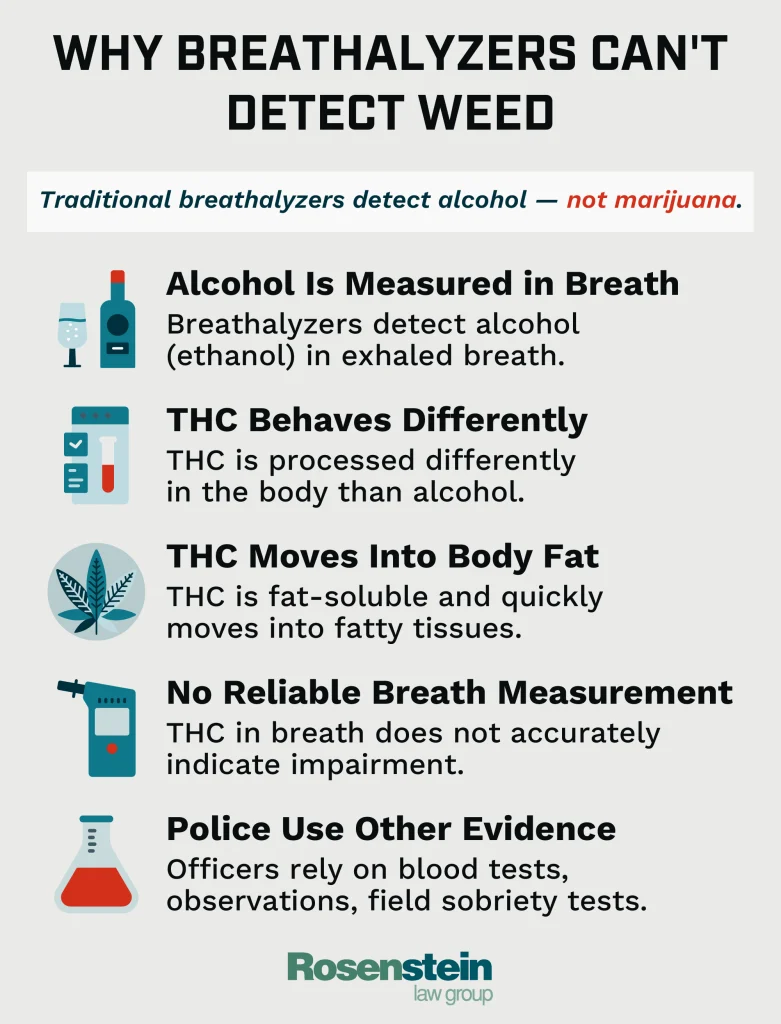
The short answer is no. Traditional alcohol breathalyzers cannot detect THC, the psychoactive compound in marijuana.
Instead, Arizona law enforcement relies on other forms of evidence when investigating suspected marijuana DUI offenses, including field sobriety testing, blood testing, and observations made during the traffic stop. Arizona Revised Statutes § 28-1381 governs DUI offenses, including those involving marijuana and other drugs.
If you have been arrested for a marijuana DUI, contact Rosenstein Law Group immediately.
Call (480) 248-7666 for a free consultation with an experienced Arizona DUI defense attorney.
No. Standard alcohol breathalyzers do not detect marijuana.
Traditional breath-testing devices are designed to measure ethanol, the type of alcohol found in beer, wine, and liquor. They estimate a driver’s blood alcohol content (BAC) by analyzing alcohol molecules present in a breath sample.
Because THC behaves very differently inside the body than alcohol, the same technology cannot determine whether someone recently used marijuana or is currently impaired.
For that reason, an alcohol breathalyzer cannot establish marijuana impairment or support a marijuana DUI charge by itself.
An alcohol breathalyzer measures ethanol in a person’s breath. Most devices used by law enforcement rely on fuel cell breathalyzer technology or infrared spectroscopy to estimate blood alcohol content.
When alcohol is consumed, ethanol enters the bloodstream and passes into the lungs, allowing an alcohol breathalyzer to estimate BAC through a breath test. Arizona’s per se legal alcohol limit is based on this relationship between breath alcohol and blood alcohol concentration.
THC does not behave the same way. Marijuana compounds are absorbed, distributed, and eliminated differently from alcohol, making marijuana impairment much more difficult to measure with a simple breath test.
The primary psychoactive ingredient in marijuana is THC, or delta-9-tetrahydrocannabinol. Unlike ethanol, THC is fat-soluble rather than water-soluble.
After marijuana use, THC quickly moves from the bloodstream into the body’s fatty tissues. As a result, THC in the blood may decline even while a person continues experiencing impairment. At the same time, inactive THC metabolites may remain detectable long after any intoxicating effects have ended.
One of the most common metabolites is THCCOOH. Unlike active THC, THCCOOH does not cause intoxication, yet it may remain in the body for days or even weeks after recent marijuana use.
Because marijuana affects the body differently than alcohol, there is no equivalent breath test capable of accurately measuring present impairment the way an alcohol breathalyzer measures BAC.
Researchers have spent years attempting to develop a cannabis breathalyzer that could measure THC in breath after recent marijuana use.
Several companies, including Hound Labs, have introduced experimental devices intended to detect THC in breath during a limited THC detection window. The goal is to identify recent marijuana use rather than marijuana use that occurred days earlier.
Although these devices have generated significant interest, no cannabis breathalyzer has become a standard roadside tool used by Arizona law enforcement. Questions remain regarding accuracy, reliability, and whether THC detected in breath directly correlates with marijuana impairment.
For now, a breathalyzer test for cannabis has not replaced blood testing or traditional DUI investigations in Arizona.
Because there is no widely accepted marijuana breathalyzer, officers investigate suspected marijuana DUI cases using multiple forms of evidence.
Depending on the circumstances, a police officer may rely on:
A urine test may also be used in certain investigations, although blood testing is generally more common in Arizona marijuana DUI cases.
Officers use these pieces of evidence together when determining whether probable cause exists for a DUI arrest.
Arizona has some of the country’s strictest DUI laws involving marijuana.
Under Arizona Revised Statutes § 28-1381(A)(1), it is unlawful to drive or be in actual physical control of a vehicle while impaired to the slightest degree by any drug, liquor, vapors or combination.
Arizona Revised Statutes § 28-1381(A)(3) separately prohibits driving or being in actual physical control of a vehicle while there is a drug identified in A.R.S. § 13-3401, or its metabolite, in the driver’s body.
Section (A)(3) is sometimes described as a per se DUI or zero-tolerance law because it does not require proof that the driver was actually impaired. For marijuana, however, Arizona courts have narrowed how far this provision reaches.
In State ex rel. Montgomery v. Harris (2014), the Arizona Supreme Court held that the term “metabolite” in A.R.S. § 28-1381(A)(3) includes only metabolites capable of causing impairment.
As a result, a driver cannot be convicted under (A)(3) based solely on the presence of Carboxy-THC (THCCOOH) — the inactive metabolite that can remain in the body for days or weeks after any impairing effects have ended. Because THCCOOH does not cause intoxication, its presence alone is not enough to establish a violation of this section.
Unlike alcohol DUI cases, Arizona does not establish a legal per se THC limit measured in nanograms per milliliter (ng/mL). There is no numerical threshold comparable to the 0.08% BAC standard for alcohol.
Instead, prosecutors rely on the applicable provisions of Arizona DUI law, along with blood test results, officer observations, and other evidence gathered during the investigation.
Medical marijuana patients are not exempt from Arizona DUI laws.
Although Arizona permits qualified patients to possess and use medical marijuana, driving under the influence of marijuana remains illegal. A registered patient may still be investigated for impaired driving and may still face DUI charges if prosecutors believe the evidence supports a violation of A.R.S. § 28-1381.
The interaction between Arizona’s medical marijuana laws and DUI statutes can involve complicated legal and scientific issues, making experienced marijuana DUI legal representation essential.
Proving marijuana impairment is difficult. No single roadside test conclusively establishes impairment, and each type of evidence police rely on has its own weaknesses.
Field sobriety tests were originally developed and standardized to detect alcohol impairment and may be affected by fatigue, anxiety, medical conditions, injuries, weather conditions, or uneven pavement. Likewise, a blood test may detect THC in blood or THC metabolites without establishing precisely when marijuana was consumed or whether the driver was actually impaired.
These issues often become central to an effective DUI defense.
A marijuana DUI conviction can carry serious criminal and personal consequences.
Potential penalties include:
A criminal conviction may also affect future employment opportunities, professional licensing, housing applications, educational opportunities, and other aspects of daily life.
The penalties may become substantially more severe for repeat offenses or cases involving aggravating circumstances.
Every marijuana DUI case is different.
An experienced DUI defense lawyer can carefully review the evidence to determine whether law enforcement followed proper procedures and whether the prosecution can prove every element of the offense beyond a reasonable doubt.
Depending on the circumstances, a defense attorney may:
Because marijuana DUI cases often involve complicated scientific evidence, early legal representation can make a significant difference.
Traditional alcohol breathalyzers cannot detect weed, and there is currently no widely accepted roadside cannabis breathalyzer used in Arizona DUI investigations. Instead, prosecutors rely on blood testing, officer observations, field sobriety tests, and other evidence to pursue marijuana DUI charges under Arizona law.
If you were arrested for driving under the influence of marijuana, do not assume the state’s evidence is conclusive. Rosenstein Law Group has extensive experience defending clients against complex DUI charges involving marijuana, THC, and other drugs.
Call Rosenstein Law Group today at (480) 248-7666 for a free consultation and learn how an experienced DUI defense attorney can help protect your rights.