
available 24/7
Free Consultation
The main difference between expunged and sealed records in Arizona is what each one does to the underlying record. Record sealing conceals a record from public view but does not vacate the conviction. Expungement—which is only available for specific marijuana offenses under ARS 36-2862—vacates the conviction and treats the offense as if it never happened.
Sealing and expungement are distinct legal remedies that are often confused with each other. Below, we explain what each does, who qualifies, how to file the petition, and how each affects what appears on a background check.
The criminal and DUI defense attorneys at Rosenstein Law Group have extensive experience getting cases set aside, sealed, and expunged. We have helped many clients take an important step toward putting their convictions behind them.
Our highly skilled attorneys understand the importance of your public record to your ability to engage in everyday life activities, such as seeking work or a place to live, getting into schools, or exercising important civil rights.
We know how important it can be to your reputation to present the best possible public face. This is what record sealing and expungement can accomplish if you are eligible.
Call us today at (480) 248-7666 to schedule a free consultation to find the best approach to sealing your record. You can also contact us online.
Sealing a criminal record prevents the public from examining it, including in most background checks. When a court grants your petition to seal under ARS 13‑911, this means, for example, that your employer, your landlord, or the general public cannot see it.
So, in all but just a few specific circumstances, you may legally state that you do not have any prior criminal convictions, the specific situations where disclosure is still required is listed in ARS 13-911(I)(5).
To be eligible for record sealing, the underlying record can be any of the following:
The relevant waiting periods are:
These are the waiting periods under ARS 13-911(E). One additional 5-year extension applies under ARS 13-911(F): if you previously had a record sealed and are later convicted of a subsequent felony, you must wait an additional 5 years beyond the standard waiting period noted above for that later subsequent offense before it can be sealed.
Some offenses cannot be sealed at all. Under ARS 13-911(O), the following are ineligible:
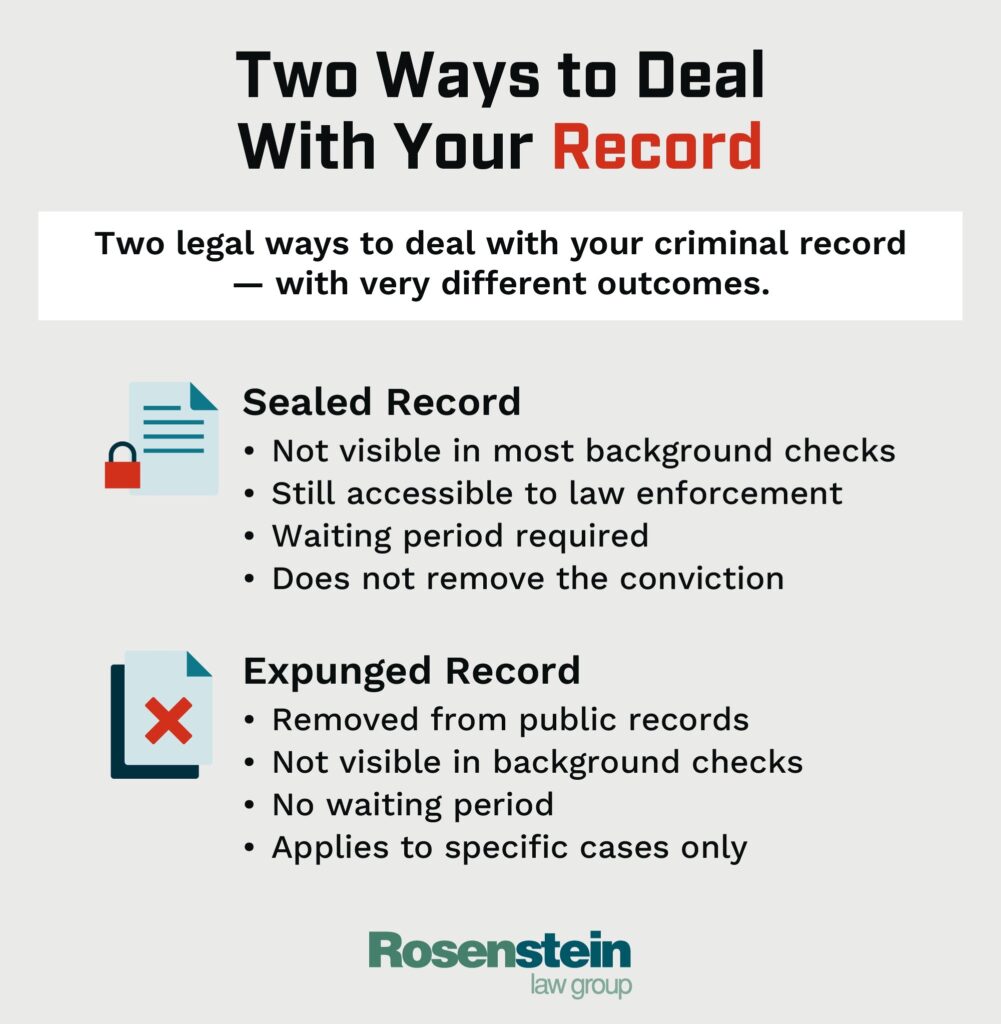
Record sealing generally works only to conceal a record, not to eliminate it. The underlying conviction is not dismissed or overturned, and your civil rights, like the right to purchase or possess firearms, are not automatically restored.
Further, record sealing does not remove any information that has already been published by third parties about the underlying record event, like news reports. Arizona law does not require third‑party publishers to remove accurate information, although you may request correction of inaccurate data.
Finally, criminal justice agencies, courts, and some government agencies can still access a sealed record for specific purposes, including:
Set-asides under ARS 13-905 do not conceal a conviction; it remains available to public access, and law enforcement agencies and anyone viewing your public record or running a background check will see it.
So, instead of providing privacy protection like record sealing does, a set-aside can release you from many of the penalties that a conviction would otherwise entail. It can also possibly make you eligible for a Certificate of Second Chance.
ARS 13‑905(P) lists specific offenses that cannot be set aside, including dangerous offenses, sex‑offender‑registration offenses, offenses involving victims under 15, and offenses for which there has been a finding of sexual motivation pursuant to ARS 13-118.
Another difference between a sealed record vs set-aside is timing. There is no waiting period for a misdemeanor set-aside—you can apply immediately upon completing your sentence. For setting aside felonies, the wait time is shorter than that required for a sealing of a record: 2 years after sentence completion for Class 4, 5, or 6 felonies, and 5 years for Class 2 or 3 felonies.
Expungement is available in Arizona under ARS 36-2862 for certain marijuana-related convictions. These include:
Expunged records are sealed and inaccessible to the public and most agencies, but the statute does not require physical destruction of all records. This is more than a set-aside and sealing, an expungement vacates a conviction and treats the offense like it never happened.
Unlike record sealing, an expungement of a marijuana related offense has no waiting period — you can file regardless of whether you have completed the sentence for the underlying marijuana offense.
The table below summarizes the difference between expunged and sealed records in Arizona side by side. When weighing expungement vs sealing, the key questions are which one you actually qualify for and what you need the result to do — keep the record out of background checks, or wipe out the underlying offense.
| Feature | Record Sealing | Expungement |
|---|---|---|
| Statutory authority | ARS 13-911 | ARS 36-2862 |
| Availability | Most criminal cases that are not on the ARS 13-911(O) ineligibility list | Certain marijuana offenses only |
| Outcome | Record hidden from public view; conviction is not vacated | Conviction vacated, charges dismissed, treated as if it never happened |
| Law enforcement access | Yes, for the purposes listed in ARS 13-911(B) | Not visible |
| Background checks | Not visible to the public, with exceptions in ARS 13-911 (J) | Not visible |
| Waiting period | Yes (2-10 years, depending on offense class) | None |
| Can say it never happened | In most situations | In all situations |
The processes for record sealing and marijuana expungement differ, but both begin with filing a petition in the appropriate court.
Under ARS 13-911(C), you file your petition in the court that handled your case:
Before you file, you must have completed all of the terms of your sentence, paid every fines, fees, and restitution ordered by the court (ARS 13-911(G)).
Once your petition is filed, the court cannot grant or deny such petition until at least 60 days have passed unless the prosecutor and any victim who has requested notice do not object to the petition (ARS 13-911(D)). The court can grant the petition without a hearing if no one objects, hold a hearing if one is requested, or deny the petition.
If the court grants the petition, it orders the records sealed and notifies the Arizona Department of Public Safety (DPS) to seal such record(s) maintained in its (DPS) criminal history records database.
If your petition is denied, ARS 13-911(L) requires you to wait three years from the date of the denial before being eligible to file a new petition to seal.
Under ARS 36-2862, you file your petition in the court that handled the original marijuana case (or, if no charges were ever filed, in the superior court in the county in which you were arrested). The court must grant your petition unless the prosecuting agency proves by clear and convincing evidence that you are not eligible. Unlike record sealing, you can file even if you never completed the terms of your sentence.
For most employers, landlords, and the general public, sealed records do not (or at least, should not!) appear on background checks. You can answer “no” to questions about arrests, charges, and convictions for the sealed offense in most contexts.
Those specific contexts that you must still answer “yes” to are set forth in ARS 13-911(I)(5) and are important to know. A sealed record must still be disclosed when applying for:
Expunged marijuana records are treated more strictly. Once a record is expunged under ARS 36-2862, it does not appear on standard background checks and is not made available to any persons except you yourself and/or your attorney who has filed a notice of appearance with the court.
One of the most pernicious effects of a criminal conviction is that it can have lingering effects on your life long after you have completed any jail or prison time and paid all the associated fines and costs.
We have already seen how an arrest record or your record of criminal offenses can harm your public reputation and cause problems when you are applying for a job or a place to live, getting a loan, going to school, or in some cases owning a firearm, obtaining certain professional licenses, and voting in elections.
Sealing of criminal records can be an effective way to reduce the impact of conviction records on your life, and if you have certain prior marijuana convictions, a record expungement is even better because it wipes out the underlying conviction.
Not all offenses are eligible for expungement and sealing. This is one area where consulting with an experienced Arizona criminal defense law firm, such as Rosenstein Law Group, can be highly valuable to you. We can review your records to identify possible candidates for sealing or expungement, and assist you with the legal process to do so under Arizona law.
To learn more about how an experienced Rosenstein Law Group attorney can help you, call us at (480) 248-7666 at any time. Or, if you prefer, you can use our online contact form to schedule a free consultation.