
available 24/7
Free Consultation
A hardship license is a limited driver’s license that lets you keep driving for essential activities — getting to and from work, school, or medical appointments — when your regular license has been suspended or revoked. In other states, you may also see this referred to as a hardship driving permit.
Arizona does not use the term “hardship license.” Instead, the Arizona Motor Vehicle Division (MVD) issues restricted driver permits that serve the same purpose. If you have searched for a hardship license in Arizona, what you are really looking for is a restricted driver permit.
In this article, we cover Arizona restricted driver permits in detail. In particular, we will:
Many times, the reason why Arizona drivers seek a restricted driving permit is because of an arrest for DUI or a conviction for driving under the influence (DUI) of alcohol or drugs, and their driver’s licenses have or will be suspended or revoked.
Rosenstein Law Group attorneys have extensive experience providing legal assistance to Arizona residents who need to find a way to still be able to drive when their driving privileges have been curtailed by a DUI arrest and/or conviction. Our DUI lawyers can help you to understand how to apply for a restricted driving permit or whether a SIIRDL is the better choice for you.
To learn more about our restricted license help services, call our law offices at (480) 248-7666, or reach us online to speak with one of our experienced attorneys and schedule a free initial consultation.
A restricted driver permit in Arizona allows you to operate a motor vehicle in limited circumstances when you cannot use your driver’s license. These restricted licenses are usually issued in cases involving DUI arrests and/or DUI convictions.
The MVD is the Arizona government agency that controls the issuance of restricted driver permits.
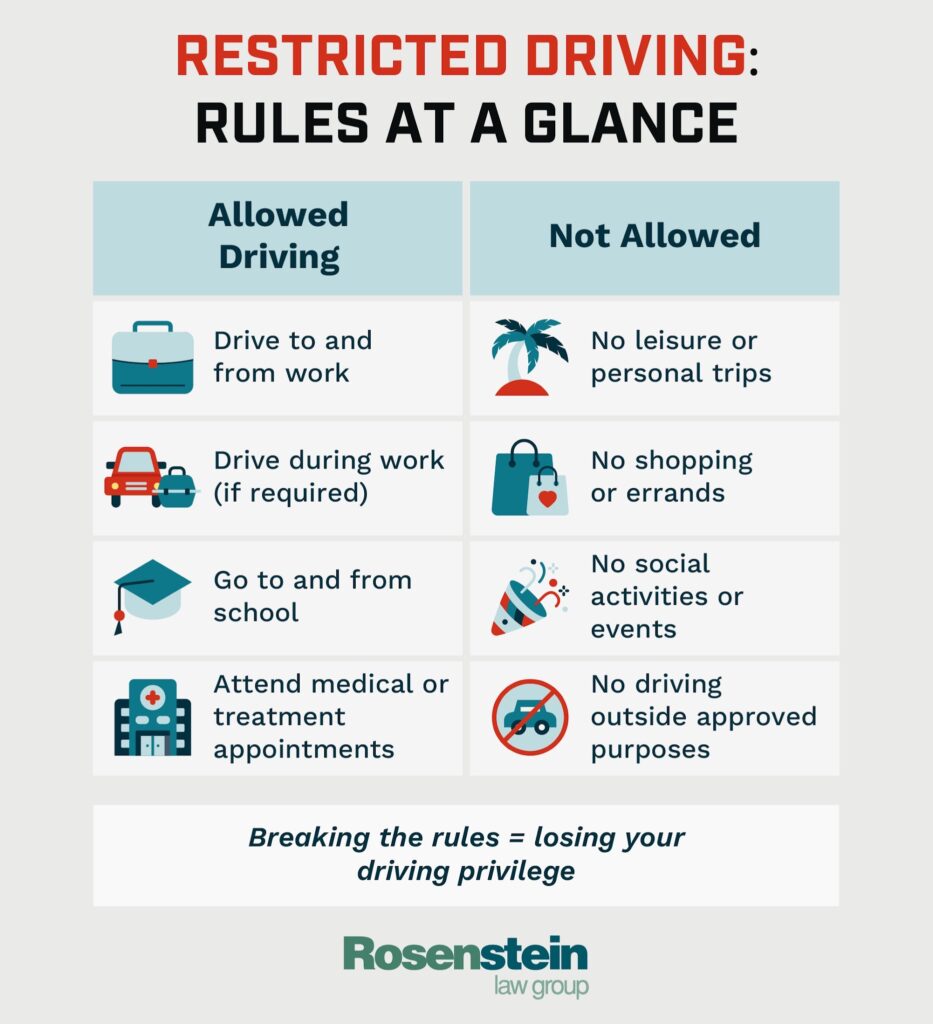
“Restricted” is no idle modifier when we describe these kinds of driver permits. When you are using such a permit, you can only drive your car in the following circumstances:
If you use your restricted permit outside these restrictions, it is a violation of your permit and may lead the MVD to revoke it. That could leave you unable to drive at all until your license suspension or revocation period ends, and you can take the steps necessary to get your license back.
How Are Restricted Driver Permits Different from SIIRDLs? (Two Forms of an Arizona Hardship License)
Arizona offers two forms of what most people would call a hardship license: a restricted driver permit and a special ignition interlock restricted driver license, or SIIRDL. Each one is a kind of restricted hardship license, but they work very differently.
A SIIRDL allows you to operate your vehicle without the narrow limitations of a restricted driver permit. You can drive your vehicle anywhere in Arizona with an SIIRDL at any time.
The key distinction between a restricted driver permit and an SIIRDL is that the latter requires you to install, use, and maintain a certified ignition interlock device in any vehicle you operate. An ignition interlock device, or IID, is a small breath-alcohol tester wired into the vehicle’s ignition system.
Before the engine starts, you have to provide a breath sample with no alcohol detected, and the device requires periodic retests while you are driving. Arizona requires the IID to remain installed for the full statutory period that applies to your offense — ranging anywhere from 6 months to 2 years depending on the specific circumstances.
Installing and maintaining an IID can make a SIIRDL more complicated to obtain than a restricted driver permit, but if you need more flexibility in your ability to drive while your license is suspended or revoked, a SIIRDL can be a potential option.
The MVD requires you to meet specific conditions to be eligible for a restricted driving permit. Many of these conditions apply to both restricted permits and to SIIRDLs.
To qualify, you must:
The specific requirements to qualify for a restricted driver permit depend on whether your license suspension originates from an insurance violation and/or a DUI.
When you are subject to a DUI charge, you will usually be presented with the choice of whether to submit to chemical testing to measure your blood alcohol content (BAC). Under Arizona’s implied consent law (A.R.S. § 28-1321), you are deemed to have consented to submit to this testing as a condition of receiving your driver’s license.
If you consent to BAC testing and fail the chemical test (BAC of 0.08% or greater), you will be subject to a 90-day license suspension, although you may be able to request a SIIRDL in many instances. Otherwise, after serving the first 30 days of the 90 day suspension you may apply to the MVD for a restricted driving permit.
If you decline to expressly consent to breath, blood, and/or urine testing to measure your BAC level, this will trigger its own implied consent suspension of your license under A.R.S. § 28-1321. The suspension is twelve months for a first-time refusal, or twenty-four months for a subsequent refusal within an eighty-four month period (7 years).
In a refusal case, a standard restricted driving permit is not available to you at all. The full implied consent suspension still runs for its statutory period. However, you may apply for a SIIRDL — provided you meet the other SIIRDL eligibility requirements, including installing a certified ignition interlock device.
If you have another DUI conviction within 84 months, or if you have been convicted of an aggravated DUI offense, then you will usually not be eligible for a restricted driving permit.
The table below summarizes the effects of a first, second, or aggravated DUI prior offense on your eligibility for a restricted driving permit in Arizona.
| DUI Level | License Action | Restricted Driving Permit Available? | SIIRDL Available? | When Driving Privileges May Resume |
|---|---|---|---|---|
| First DUI | Suspension (90 days if 21 years or older) | Yes | Sometimes | At least 30 days, subject to possible exceptions set forth in ARS 28-1385(J) and (K), in which case you may be able to apply immediately for an SIIRDL |
| Second DUI (within 84 months) | Revocation for at least 1 year | No | Yes | SIIRDL available after 90 days; without a SIIRDL – no driving for the full revocation period |
| Aggravated DUI | Revocation | No | No with one exception:*Aggravated DUI violations of ARS 28-1383(A)(3)* | *SIIRDL available after 90 days in qualifying cases; without a SIIRDL – no driving for the full revocation period* |
To recap what we have covered in this article, unlike some other states, Arizona does not refer to restricted licenses or permits as “hardship licenses” or “hardship driving permits.” But the fundamental concept of a hardship license or permit—specifically, the ability to drive to work, school, or to treatment—is the same. In Arizona, it is called a restricted driving permit.
Restricted permits are most commonly available for insurance‑related suspensions and DUI related suspensions, though eligibility depends on the specific MVD action. And within the DUI offense category, restricted driving permits are not available for some kinds of DUI, like second-offense DUIs or aggravated DUIs.
This article is meant to give you an overview of restricted driving permits in Arizona.
If you need more information, or if you have been charged with an insurance violation or DUI and want to apply for a restricted license, then we encourage you to call Rosenstein Law Group at (480) 248-7666 or to use our online contact form.