
available 24/7
Free Consultation
Can you get a DUI for sleeping in your car in Arizona? Yes, and it happens more often than people realize.
You probably already know it’s illegal to drive under the influence of alcohol or drugs (DUI), but you may not know that Arizona’s “actual physical control” (APC) law can lead to a DUI charge even when your vehicle never moves. Under APC, you can legally be in control of a motor vehicle while asleep inside it, and that is enough for police to make an arrest.
In this post, we discuss what actual physical control means under Arizona DUI law, and the factors that police, prosecutors, and juries in Arizona consider when deciding whether you were in actual physical control at the time of a DUI arrest.
Rosenstein Law Group DUI defense lawyers have over 200 years of combined experience defending clients throughout the state against DUI prosecutions, including charges based on actual physical control.
When you hire us to represent you, you can be confident that the DUI attorney assigned to your case will be fully informed about the latest case law and how to use that knowledge to your benefit.
You can schedule an appointment with one of our skilled DUI defense professionals by contacting us online here or by calling us directly at (480) 248-7666 at any time. We have offices throughout Arizona for your convenience.
Sleeping in your car is not illegal in Arizona by itself. But if you have been drinking, the answer changes.
Under A.R.S. § 28-1381, you can be charged with DUI for sleeping in a car drunk if you are in “actual physical control” (APC) of the vehicle, even if the car never moves and you never turn the key.
Arizona’s DUI law, ARS 28-1381, makes it unlawful to drive or be in actual physical control of a motor vehicle. This raises the immediate question of what “actual physical control” means under Arizona law.
Unfortunately, Arizona statutes do not define this term. So, it has been up to Arizona courts to decide what it means through a series of decisions that, taken together, provide guidance on the factors to look for.
According to these court decisions, actual physical control over a vehicle means having the present ability to operate or control it, even if you are not driving it.
The specifics of how to determine actual physical control have changed since 1954, the year of the first Arizona appeals court decision to consider the question involving a sleeping vehicle occupant.
At first, when determining actual physical control of the vehicle, courts paid particular attention to factors like whether the vehicle was parked off the road and whether the motor was running. This analysis was called the “safe harbor” or the “two-prong” test.
Since the Arizona Supreme Court’s decision in State v. Love in 1995, Arizona courts have applied a totality-of-the-circumstances test rather than the earlier, two-pronged safe-harbor approach.
Today, when considering whether you are in actual physical control of a vehicle, even if you are sleeping, the jury must look at all the relevant facts on a case-by-case basis. Over time, examples of the factors that juries will consider when deciding the question of actual physical control have included:
A unifying thread under all of these factors is whether you posed an imminent threat to public safety by resuming driving.
So, it should be apparent by now that yes, you can get charged with DUI even if you are asleep in your car, as long as the totality of the circumstances suggests that you pose an imminent threat to the safety of the public.
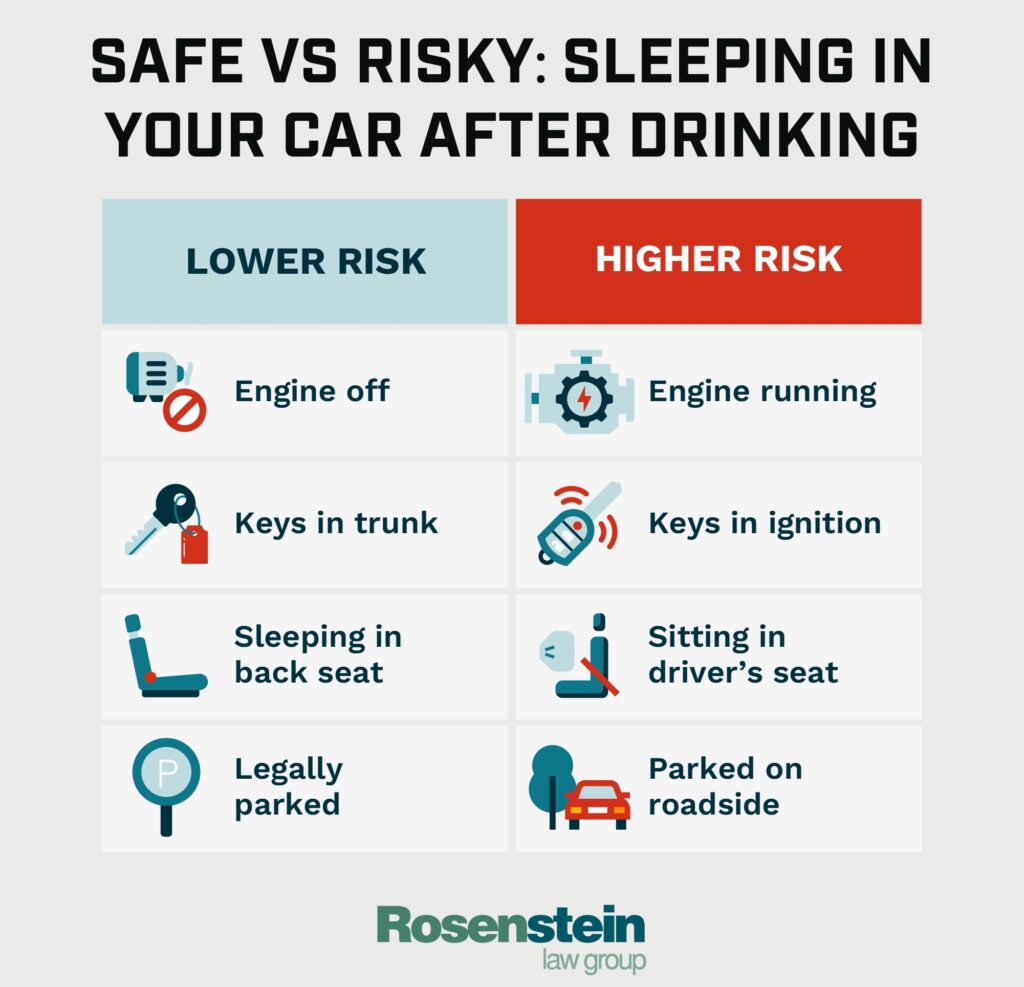
The simplest advice to keep from being found in actual physical control is to not get behind the wheel of a car after you have been drinking alcohol. Find a place to sleep indoors, or have someone drive you home. You cannot have the capability to pose an imminent threat to the public by resuming driving when you are not in the vehicle.
If you must sleep in your car, then you can take the following steps to reduce the risk of being found in actual physical control.
It may seem counterintuitive at first, but when you consider the public safety reasons that underlie it, the fact that you can be found guilty of DUI while sleeping in your car makes sense.
The police and the courts will not spend time second-guessing your intention. The focus is on the potential threat you would pose to other drivers, pedestrians, and anyone else if you start driving again on a public road while you are intoxicated.
If you follow the advice we have laid out above, you can significantly reduce the risk of being found in actual physical control, whether asleep or awake. But if for any reason you are facing DUI charges in Arizona, then call Rosenstein Law Group immediately so a skilled DUI lawyer can prepare the strongest possible defense for you, given the totality of your circumstances.
You can reach us at (480) 248-7666 any day, any time, to speak with one of our experienced DUI attorneys and schedule a free, confidential initial consultation. Or, you can contact us through our online contact form, and we will reply promptly.