
available 24/7
Free Consultation
If you have been pulled over for suspected drunk driving in Arizona and asked to blow into a breath testing device, you are probably wondering how to pass a breathalyzer test and whether it is even possible after a drink.
One of the ways you can be charged with driving under the influence of alcohol (DUI) is based on your blood alcohol content (BAC), and the presumed legal limit of impairment in Arizona is 0.08%. A common way police measure your BAC is by having you provide a breath sample into a breathalyzer.
Ever since breathalyzers were introduced into police service in the mid-1950s, people have tried to find creative ways to interfere with their operation. Modern breathalyzers, however, are almost impossible to fool into giving a false reading.
A BAC of 0.08% creates a presumption of impairment, but Arizona can charge DUI even when a driver is under 0.08% if impairment can be proven beyond a reasonable doubt. A BAC of 0.15% or 0.20% triggers Extreme or Super Extreme DUI charges under A.R.S. § 28-1382.
The best defenses are not based on trickery or gimmicks, but on challenging the technical and legal grounds of the test result, which is why it is important to hire an experienced DUI attorney to represent you.
Few law firms devote as much time to the ongoing continuing legal education and certification needed to stay abreast of the latest developments in Arizona DUI laws and defenses as Rosenstein Law Group does.
To find out how our dedicated DUI lawyers can make a real difference for you, call us any time at (480) 248-7666 or contact us online for a free initial consultation. We have law offices in Scottsdale, Tempe, and Gilbert for your convenience.
Breathalyzers measure your breath alcohol concentration (BrAC) — the amount of ethanol in an exhaled test sample — using sensors based on fuel cell or infrared technology.
They then convert that BrAC measurement into an estimated blood alcohol concentration (BAC) using a built-in conversion factor: 2100 milliliters of deep lung air contain about the same amount of alcohol as 1 milliliter of blood, a 2100:1 partition ratio.
The most common evidentiary device used in Arizona is the Intoxilyzer 9000, an infrared breath-testing instrument approved by the Arizona Department of Public Safety (DPS) Quality Assurance Program.
The portable handheld breathalyzers police carry on patrol often use fuel-cell technology to conduct breath tests. In contrast, the breathalyzers you may encounter at a hospital or a police station frequently use infrared technology.
Some more advanced breathalyzer devices use both of these technologies to improve accuracy and to filter out non-ethanol substances from the test analysis.
Because of their sensitivity and the need for precise BAC calculations to hold up as evidence, these devices must be regularly and properly maintained and calibrated in accordance with exacting federal and Arizona state standards.
For example, Arizona requires breath‑testing devices to be operated under a DPS‑approved Quality Assurance Program, which includes scheduled accuracy checks and calibration standards.
Police officers know that even the most modern and technologically advanced breathalyzers are not infallible. This is why, if an officer reasonably suspects that you are DUI, the officer will base the arrest decision on multiple factors like your appearance and demeanor, your answers to questions, and performance on any field sobriety test(s), and not just your BAC level.
This methodology also accounts for the possibility that some drivers may refuse to provide a breath sample or attempt to tamper with the breathalyzer.
Over the years, some people have promoted a variety of “hacks” to supposedly beat a breathalyzer into giving an inaccurate BAC reading. Whether these tricks have ever been effective is questionable, and modern breathalyzers are continually improving to account for attempts to contaminate the breath sample.
Still, because some of these alleged strategies have achieved the status of commonly known myths and urban legends, we will dispose of them here so you will not be tempted to make a fool of yourself in a DUI stop when the officer asks you to blow into a breathalyzer.
The apparent idea behind this trick is that if you put a penny under your tongue or suck on a battery, the copper and zinc in these items will neutralize ethanol in your breath and affect the breathalyzer’s sensor readings.
This is a fallacy that will have no practical effect other than to leave a bad taste in your mouth and possibly expose you to a lot of germs (you don’t know where that penny has been before it got to you).
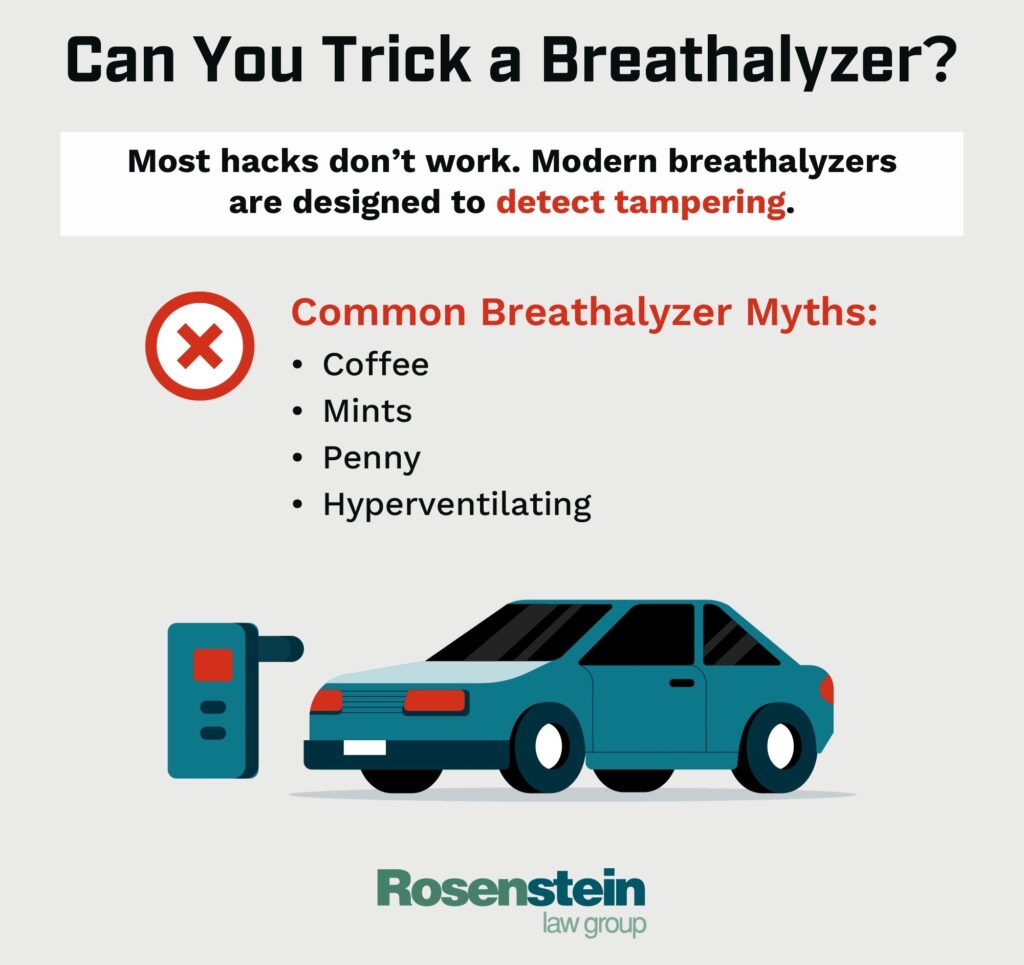
Breath mints and coffee do not affect the accuracy of a breathalyzer, no matter how many mints you put in your mouth or how much coffee you drink.
The mints or a breath spray may mask the smell of alcohol on your breath, but do not affect your breath alcohol concentration. And coffee does not affect your metabolism or how much alcohol is in your blood, although the caffeine may make you “feel” more sober.
Some efforts to fool the breathalyzer have a little more science behind them than others.
The idea of hyperventilation is that rapid, deep breathing can increase the amount of carbon dioxide in your breath and slightly lower the alcohol vapor concentration in the breathalyzer sample.
Some studies have borne this out, but the problem is that a reduction of your breath alcohol content by as much as 15% still is not enough to pass a breathalyzer test. On top of that, this effect is only temporary, dissipating within minutes, and police officers are trained to recognize deliberate hyperventilation.
So, if the officer suspects you of trying this trick, then chances are good that the officer will simply wait you out until you can’t keep it up anymore and then have you blow into the breathalyzer again.
Holding your breath for a prolonged period before exhaling into the breathalyzer may temporarily concentrate the air in your lungs, raising your BAC by up to 15% and possibly skewing the test result. Still, as with hyperventilating, police officers are trained to spot this behavior and will likely ask you to submit a second sample later.
The breathalyzer indeed uses a method based on deep lung air, so some people may be tempted not to exhale fully when blowing into it. Modern breathalyzers, however, will detect it if you provide insufficient air volume, so you will have to retest until you do.
As with hyperventilating, police officers during DUI stops will simply wait you out until you provide a valid sample, or if you still keep short-blowing the test, may finally conclude that you have refused to comply with your implied consent in Arizona to submit to chemical testing.
Now that we understand some of the folk methods of trying to trick a breathalyzer that will not work, let’s address some other methods that technically can affect your sample – and why they still don’t work.
Residual alcohol in your mouth or throat (often called mouth alcohol) can skew a breath alcohol reading. This happens if you just had a drink, swished alcohol-based mouthwash and spat it out, or burped up alcohol from your stomach.
Similarly, a medication that contains alcohol, such as a cough syrup, mouthwash, or anesthetic gel, can leave residual alcohol in your mouth and trigger a false positive. Cough syrups, for example, can contain as much as 10% alcohol by volume.
There are three reasons this will not be effective in defeating a breathalyzer test.
GERD symptoms can, at least in theory, bring alcohol vapors from your stomach up into your mouth, and possibly increase breath alcohol content. The scientific validity of this idea, however, is questionable.
Furthermore, as with deliberate attempts to influence an evidentiary breathalyzer test with residual alcohol, the test operator will observe you for at least 20 minutes before administering a breath test to minimize the risk that acid reflux symptoms might affect the sample you give.
Lastly, if you claim that GERD symptoms are the reason for failing a breathalyzer test, then you will usually need to back up this claim by providing a different kind of test, like a blood test, that shows a significantly lower alcohol content.
If you are following a strict low-carb diet or have been fasting, or if you have diabetes with uncontrolled blood sugar, your body can enter a metabolic condition known as ketosis. This means your body is burning its fat reserves, which produces acetone in your blood.
Your liver can convert some acetone into isopropyl alcohol. Although this is not the same as ethanol in an alcoholic beverage, some older breathalyzers can confuse the two and give a false reading.
But modern breathalyzers are subject to federal standards that require them to distinguish between ethanol and isopropyl alcohol at the 0.02% level, so this is rarely a good way to challenge the results of a breathalyzer test.
A few kinds of foods can produce trace amounts of alcohol vapor through fermentation. Examples include overripe fruit, sourdough bread, and some “near beer” non-alcoholic beverages that contain up to 0.5% alcohol by volume.
These items are generally not enough to raise an adult’s BAC reading to the 0.08% level, but in some edge cases, like when the breathalyzer device is highly sensitive, and you provide the breath sample right after consuming them, they can trigger a false positive result.
Food fermentation and non-alcoholic beverage consumption are mainly an issue for minors, because it is illegal for them to have any alcohol in their bodies.
One of the more creative approaches tried by a few people has been to consume an absorbent material, such as cotton, before taking the breathalyzer test; in at least one notable example, an individual reportedly ate his own underwear.
This is a completely ineffectual tactic; the cotton might only absorb the alcohol in your stomach, but not from your bloodstream.
You probably already know the answer to this question: Don’t drink and drive. Modern breathalyzers are the result of decades of technological advances and iterative refinements, to the point where they are designed to detect and resist masking and tampering efforts. This means that trying to deceive them is virtually futile.
Instead, if you have been arrested or charged with DUI in Arizona and part of the reason is a BAC at or above the legal limit of 0.08%, your best defense options lie in challenging the technical aspects of how the police used a breathalyzer and how it has been maintained.
If you get stopped for suspicion of DUI, then you may face two kinds of breathalyzer testing: roadside and station testing.
During a traffic stop, the police officer who stops you for suspicion of DUI may request that you take a preliminary breath test (PBT), also called a portable breath test, before making an arrest.
This roadside test is not for evidentiary purposes in criminal court. Still, the officer may use it as part of the determination as to whether probable cause exists to arrest you for suspicion of DUI.
If the police officer arrests you for DUI, then you may be asked to take a breathalyzer test at the police station, DUI processing van, or a medical facility. The purpose of this test is evidentiary.
It is important to understand the difference between these two breath tests in the context of what happens if you refuse to submit to the test under Arizona’s implied consent law (A.R.S. § 28-1321):
Refusing the roadside preliminary breath test (a small handheld device) does not trigger penalties under the implied consent law.
Refusing the breath test at the station or in the DUI van — which is administered on the Intoxilyzer 9000 — will cause you trouble under the implied consent law.
You can refuse to provide a breath sample on the Intoxilyzer 9000 at the police station, but if you do, then Arizona’s implied consent law imposes some strict penalties:
If you refuse to take an evidentiary breathalyzer test, then you have 30 days to request a hearing with the Arizona Motor Vehicle Division to contest the suspension.
Issues that can be considered at this hearing include whether the arresting officer had reasonable grounds to arrest you for suspicion of DUI and whether you failed to expressly agree/consent to submit to chemical testing after a proper warning of Arizona’s implied consent law. Absent a technical error, such as the officer failing to warn you of the consequences, the suspension is often upheld.
Most first‑time refusal suspensions allow a restricted interlock license (“SIIRDL”) provided screening and interlock installation requirements are met.
If you have already been convicted of a DUI in Arizona and are now on probation, you may be subject to ongoing breath testing as a condition of that probation. Probation conditions for felony-level DUI offenders commonly include random breath, urine, or blood testing, scheduled check-ins, and a certified ignition interlock device on any vehicle you drive.
Failing one of these tests, or refusing to take one, can be treated as a probation violation, exposing you to revocation of probation and re-imposition of any suspended jail time.
The honest answer to “how to pass a breathalyzer test for probation” is the same as the answer to how to beat a breathalyzer anywhere else: do not drink alcohol. There is no reliable trick that will fool a properly calibrated, certified breath testing device. But probation tests can still be inaccurate.
If you believe a probation breath test produced a false positive because of mouthwash, GERD, ketosis, an inhaler, or a medication containing alcohol, call an Arizona DUI attorney at Rosenstein Law Group immediately.
A DUI lawyer can request a confirmatory blood test, examine the device’s calibration and maintenance logs, and challenge the result before your probation officer files a petition to revoke your probation. Rosenstein Law Group offers a free consultation to help you get advice before a probation violation hearing.
The most common and effective defenses in a DUI case based on a breathalyzer test focus on human error rather than mechanical unreliability. Police officers are humans, and humans make mistakes.
Here are some of the ways that improper training or failing to follow procedures can raise a reasonable doubt about the validity of a breathalyzer test result.
Breathalyzers must be regularly calibrated and well-maintained to produce accurate results. Arizona law requires the prosecution to show that the device was in proper operating condition with recent calibration checks and a clean maintenance log.
If the breathalyzer was overdue for calibration or had a history of errors and repairs near the time of your test, this can undermine the reading’s reliability.
Arizona requires that only trained, certified operators conduct evidentiary breath tests. Operator certification falls under the Department of Public Safety’s Quality Assurance Program, and officers must hold a valid breath-test operator permit to administer an evidentiary test.
If the operator was not properly certified or deviated from the approved procedure, the test result is called into question. Even simple mistakes, like ending the test early, misreading the device, or not following instructions, can invalidate the test result.
As we noted above, for an evidentiary breathalyzer test, an observation period of at least 20 minutes is needed to ensure that no residual mouth alcohol taints the sample.
A.R.S. § 28-1323 requires two breath samples within 0.02% agreement or a single breath sample after a 20‑minute observation period. If the person administering the test did not truly watch you during this interval, or if you burped or vomited in your mouth and that person did not notice, then this can compromise the evidentiary foundation of the test.
As we have seen, many breathalyzers use a default conversion partition ratio of 2100:1 when calculating BAC levels. But if you can show that your personal blood-to-breath ratio was below 2100:1 at the time of the test, then it is possible that the breathalyzer would overstate your true BAC.
Factors like your body temperature, breathing patterns, or lung capacity can further skew the relationship between a breath alcohol reading and your blood alcohol concentration. Arizona courts allow scientific experts to discuss these issues, which can introduce reasonable doubt.
This is not a challenge to the breathalyzer’s accuracy, but if your DUI stop or arrest was legally flawed in another way, the breath test result may be thrown out.
For example, if your initial stop lacked reasonable suspicion or your arrest lacked probable cause, your attorney can file a motion to suppress all evidence obtained from the stop or arrest, including any breathalyzer test results.
If you failed or refused a breathalyzer in Arizona and need help now, the experienced DUI legal team at Rosenstein Law Group can help. We offer a free initial consultation and will take your call anytime, day or night.
Rosenstein Law Group provides tough, smart, aggressive DUI defense throughout Arizona. Our DUI attorneys offer clients high-quality, compassionate, judgment-free legal representation.
Call us at (480) 248-7666 or use our online contact form.