
available 24/7
Free Consultation
If you have been arrested for driving under the influence (DUI) of alcohol or drugs in Arizona, then, depending on the nature of your conviction, your Arizona driver’s license may be subject to an administrative suspension in addition to any criminal sentencing.
Fortunately, Arizona law provides a path to a restricted license after a DUI — either through a restricted driving permit or through a special ignition interlock restricted driver’s license (SIIRDL).
In this article, we explain how each option works, the mandatory hard suspension period you must serve in some instances, what steps you must complete, and what a restricted license actually allows you to do.
If you have been arrested for or charged with DUI in Arizona, Rosenstein Law Group DUI defense attorneys can represent you. We provide legal counsel throughout all phases of the DUI process, from pre-trial negotiations to trial defense.
We also help clients maintain their Arizona driving privileges if they are charged with or convicted of DUI.
To speak with an experienced Rosenstein Law Group defense lawyer, call us any time at (480) 248-7666 to schedule a free initial consultation. Or, you can use our online contact form to reach us.
After a DUI, you have two basic options to apply for a restricted license in Arizona: a Restricted Driving Permit (RDP) or a Special Ignition Interlock Restricted Driver’s License (SIIRDL).
Before you can drive on a restricted driving permit in Arizona, with one exception, you must first complete a mandatory “hard” 30-day suspension period during which you cannot drive at all. The exception is:
If this exception does not apply, then the length of the hard suspension depends on the type of suspension you are on:
Do not drive during any hard suspension period. Any DUI while your license is suspended can trigger an aggravated DUI Class 4 felony charge under A.R.S. § 28-1383.
A restricted driving permit allows you to drive in limited situations:
To be eligible for a restricted driving permit, you must:
If you meet these conditions, then you can apply for a restricted driving permit at a Motor Vehicle Division (MVD) office or through an authorized third-party driver’s license provider.
After a first‑offense Admin Per Se suspension, you may apply for a restricted permit after 30 days upon your successful completion of alcohol and/or drug screening. For a second Admin Per Se suspension within 84 months, a restricted permit is not available, and you must serve the entire “hard” 90-day suspension.
The main advantage of a Restricted Driving Permit is that it does not require you to install a certified ignition interlock device (IID) in any vehicle that you operate.
The main drawback to this kind of restricted permit is that you are restricted in where and under what circumstances you can drive, and you have to withstand the first 30 days of the 90 with a hard suspension – no driving.
If you want to drive during the suspension period and are willing to have an IID installed in any vehicle you drive, then an SIIRDL may be the better choice for you. As with restricted driving permits, the Motor Vehicle Division (MVD) of the Arizona Department of Transportation issues an SIIRDL.
Generally speaking, to qualify for an Arizona SIIRDL after a DUI arrest, you must meet all of the following conditions:
Typically, IID requirements range from 3 (SIIRDL for Admin Per Se suspension) to 12 – 24 months for a DUI conviction, depending on the DUI classification. If you install your IID before your conviction, the time you serve with an SIIRDL may be credited toward your overall IID requirement in the event you are convicted of DUI, provided your SIIRDL was issued on or after January 1, 2023, and you are over the age of 21.
Declining to give your consent to blood, breath, or urine testing after a DUI arrest triggers a separate automatic license suspension under Arizona’s implied consent law (A.R.S. § 28-1321).
The suspension length and SIIRDL waiting period are listed in “The Mandatory Hard Suspension Period” above: a first refusal carries a 12-month suspension with an SIIRDL available upon IID installation, and a second refusal within 84 months carries a 24-month hard suspension – no SIIRDL eligibility.
You can still apply for an SIIRDL during either of these suspension periods, provided you satisfy all the other eligibility requirements.
In some cases, you may be able to have your IID removed after six months, followed by a six-month probationary period. Here are the conditions you must satisfy to qualify:
Your SIIRDL expires when the suspension or revocation period that the SIIRDL is attached to ends. When your SIIRDL expires, your official IID timeframe will start — but you still need to complete reinstatement at an MVD office before you can legally drive on a full license again.
Once your SIIRDL expires, you will need to complete any remaining license reinstatement requirements before you can get your Arizona driver’s license restored. These may include:
In Arizona, an aggravated DUI is a felony that usually results in license revocation instead of suspension. Aggravated DUI occurs when:
An SIIRDL is only available for aggravated DUI under A.R.S. § 28-1383(A)(3) (a person under 15 years of age in the vehicle), and only if no death or serious physical injury occurred.
If your aggravated DUI falls under A.R.S. § 28-1383(A)(3), you may qualify for an SIIRDL, but only if all of the following conditions apply:
Any violation of your SIIRDL IID requirements will result in cancellation of your SIIRDL. Examples include:
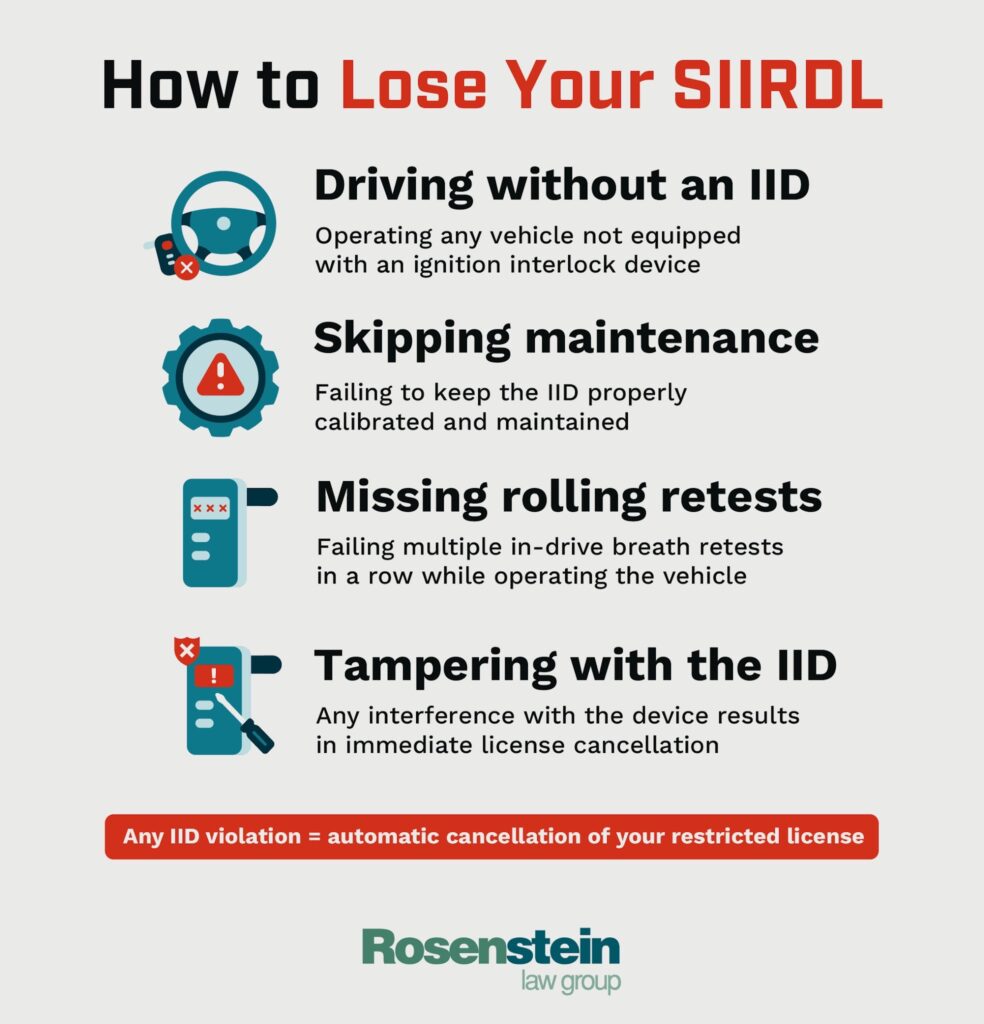
A restricted license is not a full reinstatement of your driving privileges — but for most people, it is the difference between keeping a job and losing it. What you can actually do with a restricted license depends on which kind you qualify for.
With a Restricted Driving Permit (RDP), you can:
With an SIIRDL, you can:
Either type of restricted license can be canceled for any violation of its conditions. Drive only within the scope your permit or license allows, and — if you hold an SIIRDL — keep your IID calibrated, maintained, and free of tampering.
Whether you are applying for a Restricted Driving Permit, an SIIRDL, or full reinstatement after your restricted license expires, the core steps for DUI license reinstatement in Arizona are the same:
Missing any one of these steps, or letting your SR-22 lapse, can delay or cancel your restricted license.
Having a suspended license in Arizona can have a tremendous negative impact on your ability to work, attend school, or even perform everyday activities like buying groceries or seeing a doctor or dentist.
Even if your license has been suspended or revoked, by applying to the Arizona Motor Vehicle Division, you may be able to reinstate at least some of your driving privileges through a DUI restricted license — either a Restricted Driving Permit or an SIIRDL. A Rosenstein Law Group DUI attorney can help you if you have been arrested for suspicion of DUI and are facing a driver’s license suspension or revocation.
To find out more, we are a phone call away at (480) 248-7666, or you can contact us online at any time to schedule a free consultation with one of our highly experienced DUI lawyers.