
available 24/7
Free Consultation
Unlike some other states, neither Arizona law nor the Arizona Department of Transportation’s Motor Vehicles Division (MVD) does not use the terms “conditional license” or “conditional driving license” to describe a driver’s license with restricted driving privileges.
Instead, when we consider the question of a conditional license vs a restricted license, Arizona refers to two kinds of restricted licenses: a restricted driving permit and a special ignition interlock device restricted driver’s license (SIIRDL).
Both of these restricted licenses are forms of conditional licenses, in the sense that they place conditions on your ability to drive a motor vehicle when your Arizona driver’s license has been suspended or revoked.
If you need to apply for a restricted driving permit or a SIIRDL, it is often because your Arizona driver’s license has been or will be suspended or revoked. This usually occurs in the context of traffic violations or a driving under the influence (DUI) charge, which many drivers commonly think of as a conditional license DUI situation.
It is important to know that restricted permits are not available for every kind of suspension. For example, suspensions tied to reckless driving, failure to appear, failure to pay fines, medical revocations, and certain criminal-court-ordered revocations generally do not qualify.
Rosenstein Law Group criminal defense and DUI defense attorneys are highly experienced in providing legal representation to residents of Maricopa County and Arizona generally, including requesting limited driving privileges.
If you need help defending your legal rights against a drunk driving charge, we can help. We can also advise you on which form of restricted driving license in Arizona is best for your specific driving needs, and on how to restore your suspended or revoked Arizona driver’s license.
To speak with one of our experienced legal professionals, call us at (480) 248-7666 or use our online contact form. You can reach us any day, 24 hours a day.
To apply for a restricted driver permit or a SIIRDL, you will need to meet certain MVD eligibility requirements (MVD, not the court, issues restricted licenses in Arizona in most circumstances).
Eligibility typically requires completing 30 days of an Admin Per Se DUI suspension under A.R.S. § 28-1385, or 90 days if the suspension is for an implied-consent refusal without any other such refusals within an 84-month period under A.R.S. § 28-1321, and meeting other conditions, including:
Under ARS 28-1385(J) and (K), you may be able to request a SIIRDL without having to complete the waiting periods above (30 days or 90 days) if:
If you are applying for a SIIRDL, you will also need to have a certified ignition interlock device (IID) installed in any vehicle you drive (this is not required for a restricted driver permit).
Some additional factors, like past DUI convictions or failing to observe Arizona’s implied consent to chemical testing, can lead to additional legal complications that can delay or, in some cases, even preclude you from qualifying for a conditional license.
An experienced Rosenstein Law Group attorney can help you to navigate the further legal complications involved with these specific circumstances.
As forms of conditional licenses, the key differences between a restricted driver permit and a SIIRDL are:
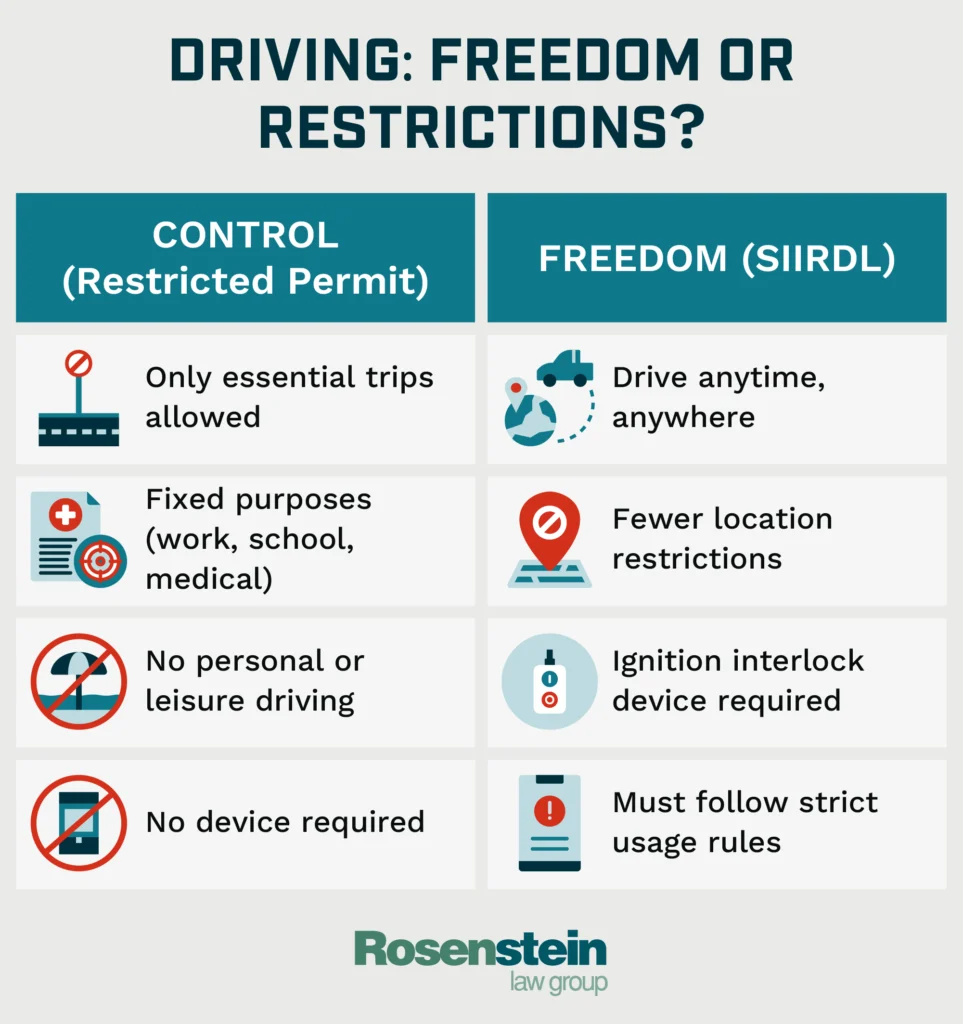
Getting a SIIRDL costs more (you will be responsible for the costs to install and maintain the IID in vehicles you drive), and imposes more obligations on you to keep the IID in proper working order. But the SIIRDL offers you considerably more freedom in where you can drive.
Restricted driver permits and SIIRDLs in Arizona provide you with temporary driving privileges.
You can lose your driving privileges under these particular licenses if you fail to comply with the conditions they impose on you:
If you are caught violating these conditional license requirements, the MVD can revoke your restricted driver’s permit or SIIRDL eligibility. You will not be able to drive again until your suspension or revocation ends and your driving privileges are restored.
When you lose your regular Class D or G driver’s license because of a DUI or an insurance violation, you do not have to wait until your suspension or revocation ends. Obtaining a restricted license or a limited driving permit can enable you to keep at least some road mobility until you can get your driver’s license back.
A Rosenstein Law Group DUI attorney can defend you against a DUI charge. Our law firm can also assist you in obtaining a restricted driver’s license or a SIIRDL.
We offer personalized, attentive support to all our clients in overcoming the legal hurdles to regaining Arizona driving privileges.
To find out whether you may qualify for restricted driving privileges, call us anytime at (480) 248-7666 or reach us online to speak with one of our driving privileges attorneys.