
available 24/7
Free Consultation
DUI checkpoints are a common law enforcement tactic in Arizona. Generally coinciding with the busiest travel times, like state and federal holiday weekends. The goal of DUI checkpoints is to remove intoxicated and impaired drivers from the state’s roadways.
If you have been arrested at a DUI checkpoint, you may still have valid legal defenses available to you. The Rosenstein Law Group represents Arizona motorists charged with DUI offenses, and we can evaluate your case and your legal options in a free consultation. Call us at (480) 248-7666 to speak with one of our experienced Arizona DUI defense attorneys, or contact us online.
DUI checkpoints in Arizona are coordinated efforts by county, city, and state law enforcement agencies. Officers work together to plan and organize temporary roadblocks on local roads and highways. While the news may sometimes alert the public to the presence of a DUI checkpoint, police rarely disclose the actual location.Some controversy has surrounded the use of DUI checkpoints, with some people arguing that DUI checkpoints are unconstitutionally overbroad in their application. But the U.S. Supreme Court has already held that sobriety checkpoints are legal under the Fourth and Fourteenth Amendments to the U.S. Constitution.
Checkpoints remain legal in Arizona as long as the police follow certain parameters:
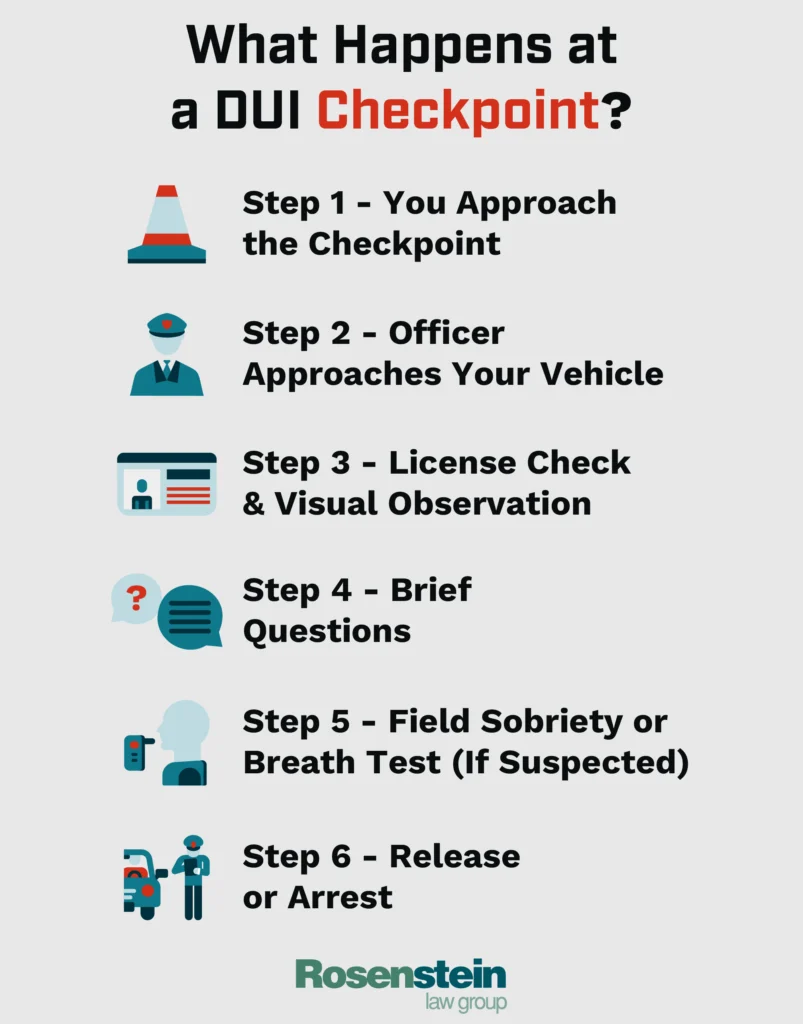
Although checkpoints are legal, not all officers conduct them lawfully. Therefore, it is imperative that you know what to expect when approaching one. Law enforcement officers generally do the following at a checkpoint:
At any time, you may refuse to speak to the police or decline to perform requested sobriety tests. However, determining sobriety is subjective, and officers can view the refusal to cooperate as evidence of intoxication.
Any refusal to take a chemical test, or breathalyzer, to confirm intoxication can result in an arrest for DUI. Additionally, you may lose your driving privileges for 12 months for refusing to submit to a breath test into an Intoxilyzer 9000, a large machine usually at the station or inside a DUI van, with a long hose you blow into. You DO NOT have to provide a breath sample into the small portable, handheld breath device or “PBT”, that is often requested of you while still on the side of the road. Refusing to submit a breath sample into a PBT does not have any implications on your driving privileges, only refusing the Intoxilyzer 9000 breath test.
Penalties and fines for driving under the influence in Arizona are severe, especially for repeat offenses. Do not let the consequences of a DUI destroy your personal, professional, and financial well-being.
No one should drive under the influence of drugs or alcohol. However, if a law enforcement officer stops you at a checkpoint, the following advice may help to preserve your legal rights:
If you are facing DUI charges, remember: you are innocent until proven guilty beyond a reasonable doubt. At Rosenstein Law Group, our attorneys will fight aggressively to defend you against the government’s charges. We stand out amongst Arizona’s DUI defense firms for our knowledge, experience, and vast resources.
Call Rosenstein Law Group anytime, day or night, at (480) 248-7666. Our team includes the only two board-certified DUI defense attorneys in Maricopa County. Call us today for your free consultation, or use our online contact form to schedule a free initial consultation.