available 24/7
Free Consultation
Under Arizona law, many kinds of non-alcoholic substances can be the basis of drugged driving charges.
In contrast to alcohol-related DUI, with its range of blood alcohol content-based offenses, including extreme and super extreme DUI, for a drug DUI charge, prosecutors can rely on the presence of a drug or its metabolites in your body while you are operating a motor vehicle or in actual physical control of it.
If you have been arrested for a drug DUI offense in Phoenix (or anywhere in the state of Arizona), Rosenstein Law Group DUI defense lawyers can provide you with the legal defense representation you need.
Our experienced attorneys can help you understand the charges you are facing and what legal defenses may be available to you in plea negotiations or at trial.
To speak with one of our drug DUI attorneys, call us at (480) 248-7666 at any time, any day of the week. You can also communicate with our legal team online to schedule a free consultation.
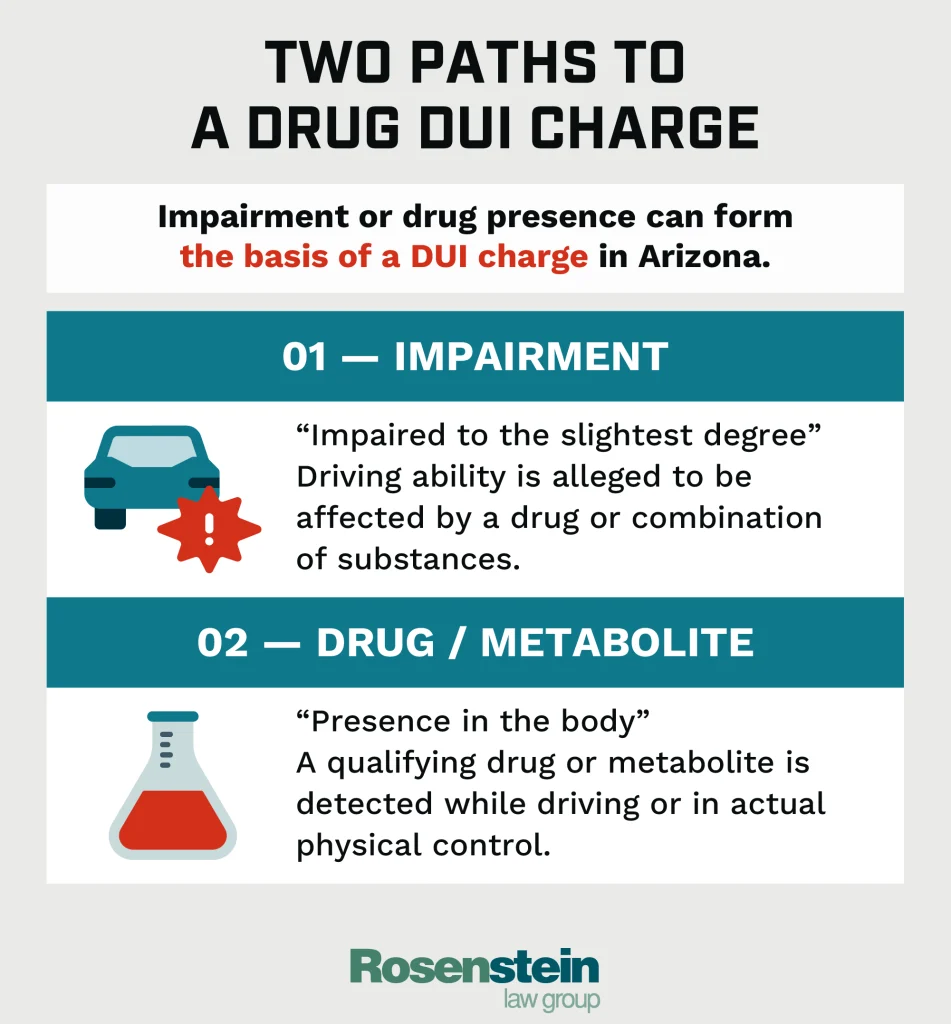
Prosecutors in Arizona rely on two main theories of liability:
Under Arizona Revised Statutes (ARS) Section 28-1381(A)(1), it is unlawful to drive or be in actual physical control of a vehicle while you are under the influence of intoxicating liquor, any drug, a vapor-releasing substance containing a toxic substance, or a combination of substances, if you are impaired to the slightest degree.
This raises the question of how a police officer who pulls you over based on reasonable suspicion of DUI decides whether you are impaired. Police and prosecutors may evaluate any of the following factors, alone or in combination, to argue that you are impaired:
Note that under ARS 28-1381(A)(1) it is no defense to an impairment charge that you are legally entitled to use the drug in question in Arizona.
ARS 28-1381(A)(3) makes it unlawful to drive or be in actual physical control of a vehicle while there is any drug defined in A.R.S. § 13-3401, or its metabolite, in your body. This legal theory is sometimes called Arizona’s “drug DUI” or “per se drug DUI” theory, and how it works can depend at least in part on whether the drug involved is marijuana.
For non-marijuana drug DUI cases, prosecutors often focus on toxicology evidence showing that a listed drug or qualifying metabolite was present in your system. In contrast to impairment-related DUIs, though, Arizona law provides a statutory prescription defense to ARS 28-1381(A)(3): if you are using a drug as prescribed by a licensed and authorized medical practitioner, then you are not guilty of violating that subsection (A)(3) of the DUI law.
Marijuana DUI cases can involve smoked cannabis, vapes, edibles, concentrates, THC products, medical marijuana, or adult-use recreational marijuana.
In marijuana drug DUI cases, the Arizona Supreme Court has held that you cannot be convicted under ARS 28-1381(A)(3) based merely on the presence of a non-impairing metabolite in your body like Carboxy-THC.
Arizona’s adult-use marijuana laws, which are found in Chapter 28.2 of Title 36 of Arizona Revised Statutes, provide that if you have marijuana metabolites or components in your body, then you are guilty of violating ARS 28-1381(A)(3) only if you are also impaired to the slightest degree (see ARS 36-2851(3) and ARS 36-2852(B)).
If you are a medical marijuana patient, the Arizona Supreme Court has held that the Arizona Medical Marijuana Act does not bar prosecution under ARS 28-1381(A)(3); but it can provide an affirmative defense if you show that the marijuana or metabolite concentration was insufficient to cause impairment (see ARS 36-2802(D)).
Drug DUI charges can involve illegal drugs, marijuana, prescription medications, over-the-counter medications, or combinations of substances. Arizona’s drug statute, ARS 13-3401, defines many kinds of drug categories like cannabis, dangerous drugs, narcotic drugs, prescription-only drugs, and other substances.
Arizona has drug schedules (ARS 36‑2512 through 36‑2516), which are based heavily on federal schedules. However, criminal drug classifications, like dangerous drugs or narcotics, are defined separately in ARS 13‑3401.
Examples of illegal drugs include:
A prescription medication can lead to a drug DUI charge if a police officer believes the medication is impairing you.
A valid prescription can be a defense to ARS 28-1381(A)(3) if you are using the drug as prescribed, but it is not a defense to an ARS 28-1381(A)(1) allegation that the medication impaired you to the slightest degree.
Over-the-counter products can create a drug DUI risk through their possible side effects. The National Highway Traffic Safety Administration warns that cold and allergy medicines, sleep aids, and other OTC medications can cause drowsiness, nausea, blurred vision, dizziness, irregular heartbeat, or shakiness. Even if an OTC medication is legal to buy, Arizona’s impairment-based DUI law applies if a prosecutor can show it impaired you to the slightest degree.
The penalties for a drug DUI depend on the specific charge, any prior history of DUIs on your record within an 84 month period, your Arizona driver’s license status, the facts of the stop, whether alcohol was also involved, whether there was a child under 15 in the car with you, whether an accident resulting in injuries occurred, and whether your case is charged as a misdemeanor or a felony aggravated DUI.
A violation of ARS 28-1381 is a Class 1 misdemeanor.
A first offense non-alcohol DUI requires at least 10 consecutive days in jail, a fine of at least $250, additional $500 assessments to two state funds, possible community restitution, Traffic Survival School, and alcohol or other drug screening, education, psychotherapy, or treatment.
The court may suspend all but one day of the jail sentence if you complete the required drug screening, education, or treatment program.
For a second DUI within 84 months, ARS 28-1381 requires at least 90 days in jail, with 30 days served consecutively, a fine of at least $500, at least 30 hours of community restitution, a one-year driver’s license revocation, additional $1,250 assessments to two state funds, and Traffic Survival School. The court may suspend all but 30 days if the person completes the required drug screening, education, or treatment program.
A drug DUI arrest can trigger Arizona MVD consequences like an administrative license suspension that are separate from your criminal court case.
According to the Arizona Department of Transportation (ADOT), if you consent to a chemical test(s) then a 90-day suspension may apply; but if you fail to expressly consent to the chemical test(s) testing, then a first refusal can result in a 12-month suspension and a second refusal within 84 months can result in a 24-month suspension.
The ADOT also states that you have 30 days from the date on the suspension notice to request a hearing to challenge the license suspension. Missing this deadline means the suspension cannot be challenged. Driver license reinstatement may require you to undergo alcohol or drug screening, to show proof of SR-22 future financial responsibility, and meet other requirements depending on the type and circumstances of the DUI.
For alcohol-related DUI cases, ignition interlock requirements are mandatory. In drug-only DUI cases, however, ADOT notes that ignition interlock is not automatically required for drug-only DUI offenses after January 1, 2017.
Still, ARS 28-1381 allows the court to order a person convicted of a DUI that does not involve an intoxicating liquor to equip any vehicle the person operates with a certified ignition interlock device, and if so ordered, then the MVD will require you to have one installed.
A drug DUI can become an aggravated felony DUI under ARS 28-1383 if certain aggravating factors exist. These include:
Aggravated DUI under subsections involving suspended license, repeat DUI, IID violations, or wrong-way driving is a Class 4 felony. Aggravated DUI based on a child under 15 in the vehicle is a Class 6 felony.
The table below summarizes aggravated DUI penalties.
| Aggravated DUI Type | Felony Class | Prison Sentence | Sentencing Range | Notes |
|---|---|---|---|---|
| Suspended or revoked license | Class 4 | Mandatory minimum of 4 months for first aggravated DUI with no prior felony convictions | 1 to 3.75 years | Suspended or revoked license is the most common kind of aggravated DUI. |
| Third DUI in 84 months | Class 4 | The 84-month period starts on the date of the commission of the other DUI, not the date of conviction. | ||
| Ignition interlock violation | Class 4 | |||
| Wrong‑way driving | Class 4 | |||
| Child under 15 in the vehicle | Class 6 | No statutory 4‑month minimum | 4 months to 2 years | This is the only Class 6 felony aggravated DUI. |
In any DUI stop, the police officer will usually not rely on only one indication of impairment but will try to build a case from multiple kinds of evidence. These can take the form of officer observations, your alleged driving behavior, field sobriety testing, a Drug Recognition Evaluation (DRE), witness statements, medication or drug evidence, toxicology testing, and Motor Vehicle Division (MVD) records.
In a drug DUI investigation, officers may focus on the reason for the stop, your driving behavior, whether your eyes are bloodshot, your speech, balance, coordination, odor, demeanor, admissions, medications, drug paraphernalia, and the facts surrounding any collision.
A Drug Recognition Expert, sometimes called a “DRE”, is a police officer trained to recognize impairment by alcohol and drugs other than alcohol. The DRE protocol is a standardized method designed to determine whether you are impaired, whether your impairment relates to drugs or a medical condition, and what drug category or categories may be involved.
The 12-step DRE protocol includes:
Toxicology tests can be used to identify a drug, metabolite, or combination of substances. Arizona’s implied consent law provides that anyone operating a motor vehicle in Arizona consents to testing of blood, breath, urine, or another bodily substance to determine alcohol concentration or drug content if arrested for DUI.
If you are charged with a drug DUI, it may give you a hopeless feeling. But if you have an experienced DUI defense lawyer on your side, like one you will receive if you hire Rosenstein Law Group, then you can be certain that your attorney will use every available legal defense on your behalf.
What follows are some of the most common defense strategies Rosenstein Law Group attorneys use to defend our drug DUI clients.
For a drug DUI charge under ARS 28-1381(A)(1), the prosecution must prove impairment to the slightest degree. Your lawyer might challenge whether the alleged signs of impairment were actually caused by drugs. For example, it may be possible to create reasonable doubt based on fatigue, anxiety, illness, injury, weather, poor instructions, footwear, medical conditions, or normal physical limitations.
If the police officer lacked reasonable suspicion to make the traffic stop, or lacked probable cause to make the arrest, or lacked a lawful basis for a blood draw, urine test, or search, your defense lawyer may seek to suppress evidence that the officer gathered during the subsequent DUI field investigation.
The DRE protocol is supposed to be standardized and systematic, but it depends on the training and experience of the officer who applies it. If the officer skipped steps, misread signs, failed to consider medical causes, relied solely on subjective observations, or reached an opinion that is not supported by toxicology, then the DRE evidence may be vulnerable to challenge.
A drug test may show the presence of a drug or drug metabolite, but presence alone is not sufficient for marijuana drug DUIs. Your defense attorney may challenge whether the substance is covered under ARS 13-3401, whether the metabolite is impairing, whether the toxicology result reflects prior use rather than impairment, whether the sample was handled properly in police chain of custody, or whether the lab interpretation is scientifically reliable and accurate.
For ARS 28-1381(A)(3) purposes, a valid prescription you used as prescribed is a statutory defense. Since marijuana was legalized in Arizona under state law, Arizona DUI law requires that you were impaired to the slightest degree; If you can show that the concentration of marijuana or its metabolite was insufficient to cause impairment is another angle to attack the prosecution’s case against you.
Compared to alcohol-related DUI charges, drug DUI cases often involve complex questions about pharmacology, toxicology, metabolism, drug consumption timing and method, DRE opinions, prescription medications, marijuana law, medical conditions, and police procedure. These differences require more specialized knowledge for your drug DUI attorney to provide you with the strongest possible legal defense.
In a criminal case like drugged driving, it is up to the state to prove beyond a reasonable doubt that you are guilty of drug DUI. The role of your defense lawyer is to identify weaknesses in the prosecution’s case that can cast reasonable doubt on the state’s case. This requires a deep understanding of the facts of your case and a comprehensive defense strategy that scrutinizes every detail of the case against you.
When Rosenstein Law Group represents you in a drug DUI case, our defense strategy starts with a thorough examination of all the facts of the stop and the arrest from the moment the police officer pulls you over, including police body-camera footage, police reports, DRE paperwork, any search warrant or consent issues, and whether the circumstances at the time of your arrest suggest that you were not impaired or not in actual physical control of the motor vehicle.
But we do not stop there. We also scrutinize law enforcement lab results and lab records to see if proper test procedures and chain of custody requirements were followed and review your prescription records and medical history.
The criminal defense lawyers on our DUI defense legal team have hundreds of years of combined legal experience among them and include nationally board-certified DUI defense specialists who will stand between you and prosecuting attorneys in negotiations and at trial.
A drug DUI conviction can have a lasting impact on your life. Possible penalties are the loss of your freedom, facing a driver’s license suspension and having other limitations placed on your driving privileges, being hit with heavy financial penalties, and possibly losing some of your civil rights.
Even after you complete all your sentence requirements through the legal system, a drug DUI conviction stays on your criminal record and can negatively affect your ability to find a place to live, to get a job, to qualify for a loan, and more.
When the stakes are this high, don’t leave your legal defense to chance. Call Rosenstein Law Group today, at any time, at (480) 248-7666 to schedule a free consultation with an experienced, high-quality drugged driving defense lawyer. Or use our online contact form to reach us.
Arizona prosecutors rely on two main theories: that you drove or were in actual physical control of a vehicle while impaired to the slightest degree by a drug, or that a drug defined in A.R.S. § 13-3401, or its metabolite, was in your body. How the second theory works can depend on whether the drug is marijuana.
Partly. Using a drug as prescribed by a licensed and authorized medical practitioner is a statutory defense to the drug-or-metabolite DUI charge. It is not a defense to a charge that the medication impaired you to the slightest degree.
A Drug Recognition Expert (DRE) is a police officer trained to recognize impairment by alcohol and other drugs. The standardized 12-step DRE protocol, which includes eye, vital sign, and muscle-tone examinations plus toxicology, is designed to determine whether you are impaired, whether it relates to drugs or a medical condition, and which drug categories may be involved.
Not automatically. ADOT notes that ignition interlock is not automatically required for drug-only DUI offenses after January 1, 2017. However, the court may order a person convicted of a DUI not involving intoxicating liquor to install a certified ignition interlock device, and if so ordered, the MVD will require it.
A drug DUI becomes aggravated DUI under ARS 28-1383 when driving on a suspended, canceled, revoked, or refused license, for a third DUI within 84 months, while required to use an ignition interlock, or while driving the wrong way, all Class 4 felonies. A DUI with a person under 15 in the vehicle is a Class 6 felony.