
available 24/7
Free Consultation
A marijuana DUI charge can place your freedom, driver’s license, reputation, and future opportunities at risk. Although marijuana is legal in Arizona under certain circumstances, the state treats impaired driving as a serious public safety matter, and getting behind the wheel after using cannabis can still result in a criminal DUI arrest and prosecution.
If you were arrested for a marijuana DUI in Arizona, contact Rosenstein Law Group at (480) 248-7666 for a free consultation with an experienced Arizona DUI attorney.
Arizona law recognizes several forms of DUI involving marijuana and other drugs. One of the most important statutes is A.R.S. § 28-1381(A)(3), which makes it unlawful for a person to drive or be in actual physical control of a vehicle while there is any drug defined in A.R.S. § 13-3401 or its metabolite in the person’s body.
THC, or delta-9-tetrahydrocannabinol, is the primary psychoactive compound in marijuana. THC for medical use under a state’s medical marijuana program was recently reclassified by the FDA as a Schedule III controlled substance under federal law, while adult recreational use of marijuana remains classified as a Schedule 1 controlled substance under federal law.
Because Arizona’s marijuana DUI laws differ significantly from alcohol DUI laws, many drivers are surprised to learn how aggressively these cases are prosecuted.
Arizona is widely considered a zero-tolerance state for marijuana DUI offenses.
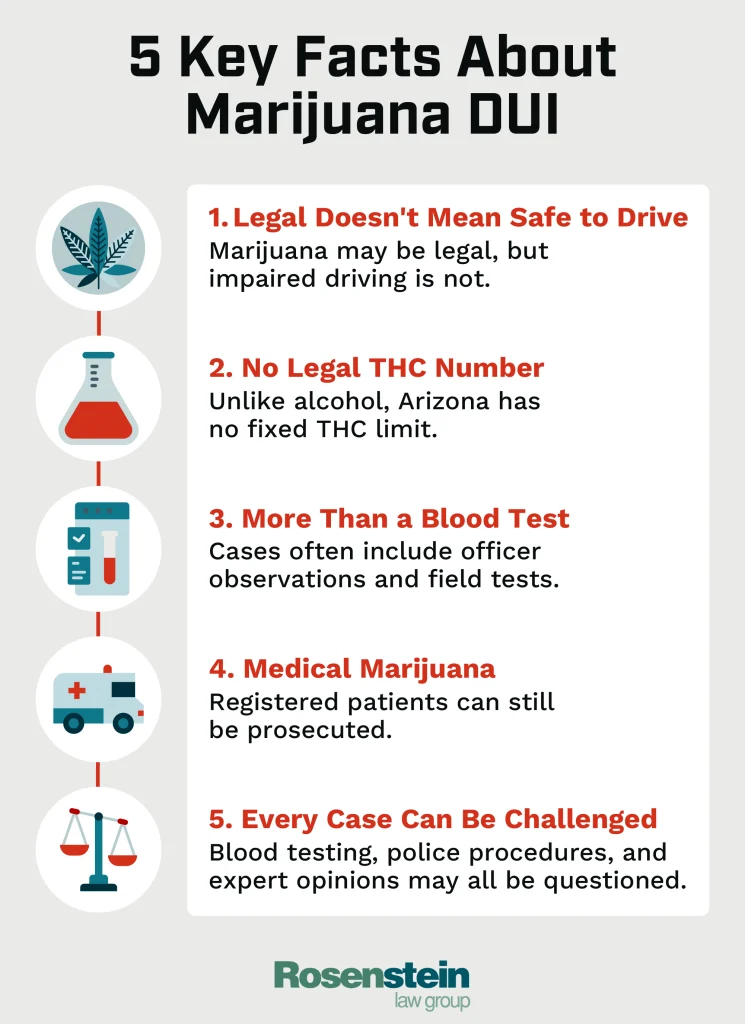
Unlike alcohol DUI cases, Arizona does not establish a specific per se nanogram-per-milliliter THC blood limit that creates a presumption of impairment. Instead, prosecutors may pursue a DUI charge based on the presence of marijuana or certain marijuana metabolites in a driver’s system.
This means a driver can face a marijuana DUI charge even when there is substantial disagreement regarding actual impairment. The prosecution may argue that any detectable amount of THC or a qualifying metabolite, along with other evidence of impairment, satisfies the requirements of Arizona’s DUI statute.
Because cannabis compounds can remain detectable long after the effects of intoxication have worn off, these cases often involve complicated scientific and legal disputes.
Yes.
The legalization of marijuana did not eliminate Arizona’s driving under the influence laws. Individuals can still be arrested and charged with driving under the influence of marijuana.
Many drivers assume that legal marijuana is treated the same way as alcohol. It is not.
Alcohol DUI cases rely heavily on BAC levels. Marijuana DUI cases often focus on THC, metabolites, officer observations, field sobriety tests, blood testing, and expert opinions regarding impairment.
As a result, even lawful medical marijuana patients and recreational users can face serious criminal charges.
Two Arizona Supreme Court decisions shape how marijuana metabolites are treated in DUI cases.
In State ex rel. Montgomery v. Harris (2014), the court held that a driver cannot be convicted under A.R.S. § 28-1381(A)(3) based solely on the presence of a non-impairing metabolite such as carboxy-THC. Because carboxy-THC can remain in the body for days or even weeks after any effects have worn off, its mere presence does not establish impairment or a per se violation.
In Dobson v. McClennen (2015), the court addressed medical marijuana patients.
It held that the Arizona Medical Marijuana Act does not immunize a registered cardholder from prosecution under § 28-1381(A)(3), but it does provide an affirmative defense: the patient may avoid conviction by showing that the marijuana or its impairing metabolite was present in a concentration insufficient to cause impairment.
Together, these decisions draw a critical line between active, impairing compounds and inactive metabolites that linger long after use. For many defendants, understanding how THC and its metabolites are interpreted under Arizona law is one of the most important aspects of the case — and often central to the defense.
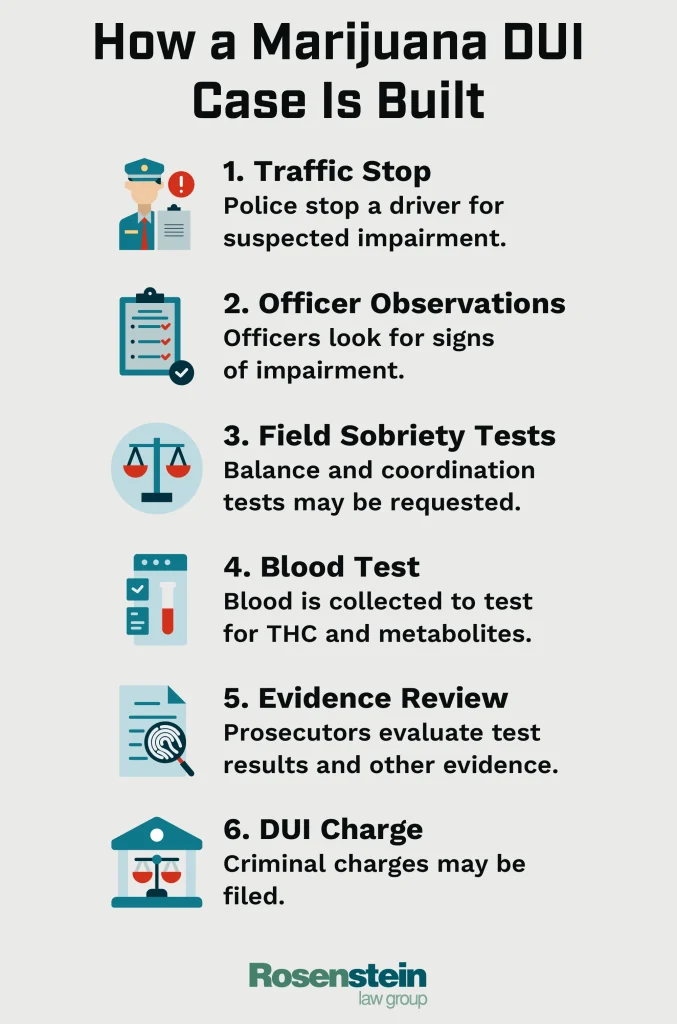
Unlike alcohol DUI investigations, no breath test reliably measures marijuana impairment.
Instead, police officers often rely on observations and circumstantial evidence, including:
Officers frequently use these observations to justify further investigation, testing, and arrest.
However, many of these factors can have explanations unrelated to intoxication.
Field sobriety tests are commonly used during marijuana DUI investigations.
An officer may ask a driver to perform exercises intended to evaluate balance, coordination, attention, and divided-attention skills.
Common field sobriety tests include:
These tests were originally developed for alcohol investigations rather than cannabis-related impairment.
Fatigue, anxiety, injuries, medical conditions, age, weather conditions, roadway surfaces, and other factors can affect performance and may provide alternative explanations for the results.
Police departments sometimes utilize a Drug Recognition Expert, often called a DRE.
A Drug Recognition Expert receives specialized training designed to identify potential impairment caused by drugs rather than alcohol.
The officer may evaluate:
Although prosecutors frequently rely on Drug Recognition Expert testimony, these opinions are not immune from challenge and should be carefully scrutinized.
Most marijuana DUI cases depend on blood testing results and are merely a single piece of evidence that the prosecution will use against you.
After an arrest, officers typically seek a blood sample to determine whether THC or marijuana metabolites are present in the driver’s system.
Unlike alcohol cases, Arizona does not establish a universally accepted per se THC threshold that establishes impairment. Any detectable presence of THC or certain metabolites may become the basis for a marijuana DUI charge.
An experienced marijuana DUI attorney will closely examine:
Problems in any of these areas may weaken the prosecution’s case against you.
Medical marijuana patients are not exempt from Arizona DUI laws.
However, medical marijuana status may become relevant when evaluating whether a person was actually impaired at the time of driving.
Many registered patients use cannabis lawfully and responsibly. Yet they can still find themselves facing criminal DUI allegations after a traffic stop and blood test.
These cases involve complicated scientific evidence and often require careful analysis by experienced marijuana DUI defense counsel.
The consequences of a marijuana DUI conviction can be severe.
A first-offense marijuana DUI is generally charged as a Class 1 misdemeanor. Potential penalties include:
A second marijuana DUI offense within 84 months carries substantially harsher penalties.
Potential consequences include:
Additional penalties may apply in aggravated DUI cases or situations involving accidents, injuries, or prior criminal history.
Many people focus only on the immediate penalties associated with a DUI case.
However, the long-term consequences can be equally serious.
A marijuana DUI conviction creates a permanent criminal record that may affect:
Even years after the case ends, a conviction may still appear in background investigations and affect important life decisions.
Every case is unique, and effective defense strategies depend on the facts.
Potential marijuana DUI defenses may include:
The prosecution must establish the required elements of the offense. Evidence challenging claims of impairment may create reasonable doubt.
Errors in collection, handling, storage, transportation, or laboratory testing can undermine the reliability of blood evidence.
An unlawful traffic stop, illegal detention, or improper search may provide grounds to challenge evidence.
Many marijuana DUI arrests depend heavily on subjective observations that can be questioned and scrutinized through investigation and cross-examination.
Drug Recognition Expert opinions and laboratory conclusions are not automatically correct nor reliable and may be challenged by qualified marijuana DUI defense expert witness testimony.
Marijuana DUI cases often involve complex scientific evidence, evolving cannabis laws, constitutional issues, and technical statutory requirements.
An experienced marijuana DUI lawyer can:
Early intervention often creates opportunities to protect a client’s rights before critical evidence is lost.
Rosenstein Law Group provides sophisticated marijuana DUI defense representation for individuals facing DUI allegations throughout Arizona. Our firm is built around the science and strategy these cases require.
Our lawyers understand the science behind THC testing, the legal issues surrounding marijuana DUI prosecutions, and the way the state uses public safety arguments to pursue convictions. We thoroughly investigate every case, identify weaknesses in the evidence, and build defenses tailored to each client’s specific circumstances.
When your future is at stake, experience matters.
A marijuana DUI arrest does not automatically result in a conviction. The prosecution’s evidence should be carefully examined, and every available defense should be explored before decisions are made about your case.
Rosenstein Law Group represents clients charged with marijuana DUI offenses throughout Arizona and provides the aggressive, strategic representation these cases demand.
Call Rosenstein Law Group at (480) 248-7666 today for a free consultation with an experienced marijuana DUI attorney.