
available 24/7
Free Consultation
In Arizona criminal law cases, including charges of driving under the influence (DUI), law enforcement needs reasonable suspicion to initiate a traffic stop and probable cause to make a DUI arrest. These terms are distinct legal concepts, and understanding their differences is important in understanding how a police officer conducts a traffic stop and makes a DUI arrest.
In this blog post, we consider how Arizona law defines reasonable suspicion and probable cause and how these two requirements work together in a DUI case. In particular, we discuss:
If you have been arrested for DUI in Arizona, the Rosenstein Law Group can represent you. To schedule a free initial consultation, call our law office at (480) 248-7666 or use our contact form to schedule a consultation.
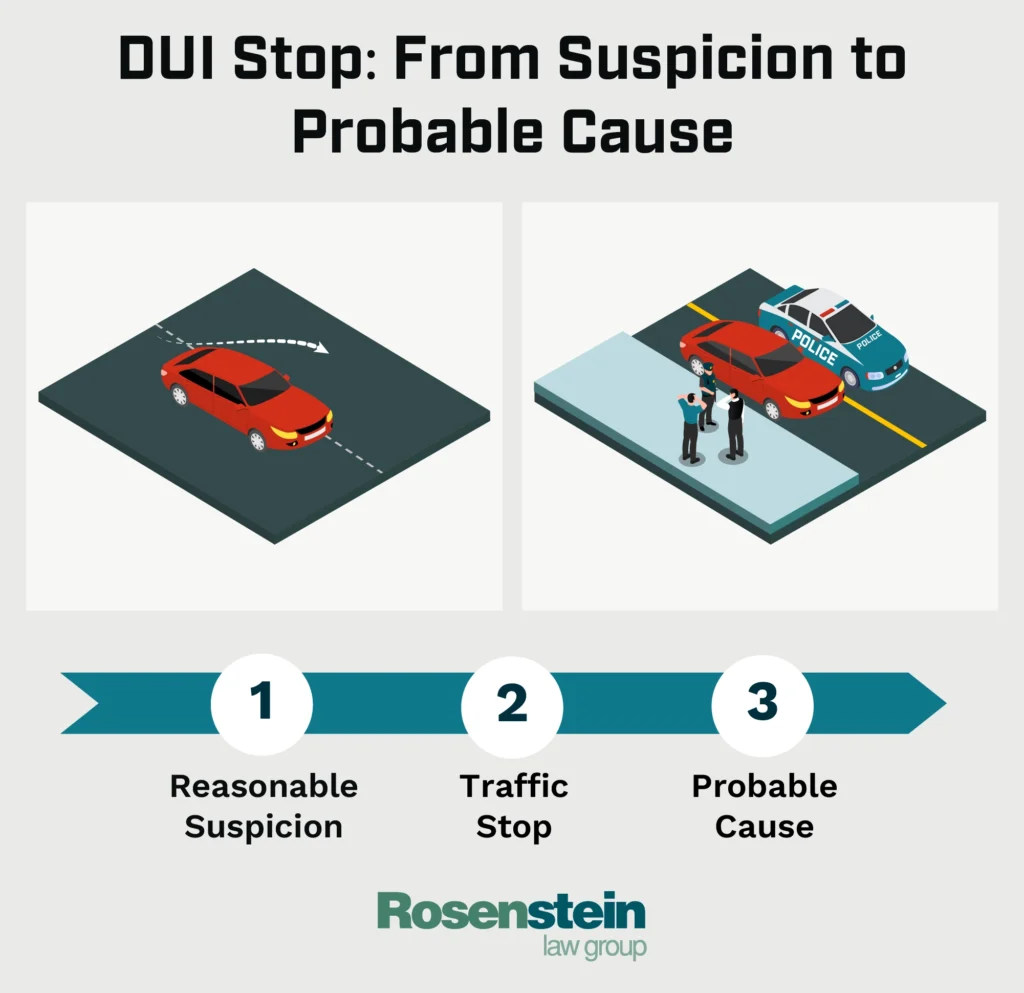
Reasonable suspicion describes what must exist for a police officer to stop and question you for suspected DUI. Reasonable suspicion means that a police officer has reasonable grounds to have a good faith reasonable belief that an offense has been committed or is in progress.
Police have a common saying: “Just doesn’t look right,” which describes a vague feeling that might first attract their attention to a driver, but that is not reasonable suspicion. Reasonable suspicion requires law enforcement officers to have articulable facts that suggest to a reasonable officer that criminal activity has occurred or is possibly occurring, not a mere hunch.
This is why police will often follow your vehicle for a while before pulling you over: they are observing you to see if you will do something, like drifting out of your lane, or even weaving inside your lane, or driving too fast or too slow, to establish a factual basis for reasonable suspicion.
At this point, the police officer does not need probable cause to stop you for suspected DUI. Reasonable suspicion is all that is required.
Reasonable suspicion is what is needed to stop you for suspected DUI. Probable cause is what is needed to arrest you for it.
Arizona law defines probable cause as “a state of facts that would lead a man of ordinary caution or prudence to believe and consciously entertain a strong suspicion of guilt.” See State v. Emery, 131 Ariz. 493, 642 P.2d 838 (1982).
Unlike reasonable suspicion, which is based on suspicion that an offense has occurred or is taking place, probable cause exists when the facts and circumstances would lead a reasonable officer to believe there is a fair probability that a crime was committed based on the totality of the circumstances observed by the officer(s).
Probable cause is required to obtain a search warrant or an arrest warrant. For example, an open container may contribute to probable cause when combined with other indicators of impairment, although it does not by itself establish probable cause for a DUI arrest.
To recap, here are the important distinctions between probable cause and reasonable suspicion:
Reasonable suspicion and probable cause both rely on the professional judgment of the police officer at the scene.
Police are human though and they can sometimes make mistakes when it comes to discerning facts and circumstances of your behavior and the surrounding circumstances.
It is possible for a police officer to believe that reasonable suspicion existed to stop you for suspected DUI, but be wrong about that conclusion.
Similarly, it is possible for a police officer to be convinced that enough evidence exists to search your car or to arrest you for DUI, and be mistaken about that as well.
The effect of a mistake in assessing reasonable suspicion or probable cause can lead to evidence obtained against you being inadmissible in a prosecution for DUI. Without sufficient evidence, the prosecution will have trouble obtaining a DUI conviction against you.
Defending against a DUI charge requires an in-depth, comprehensive approach that starts with an intensive investigation of the facts that led the police officer to stop you in the first place and to ultimately decide to arrest you.
This includes evaluating physical evidence obtained by the police, questioning any witnesses who observed the stop and the arrest, scrutinizing the police officer’s report of the stop and arrest, and getting your side of the story in detail.
These steps, and more, are what you can expect when you retain Rosenstein Law Group to represent you in a DUI prosecution.
Our experienced Arizona attorneys have 200+ years of combined experience in defending clients in DUI cases. We understand how the legal standards of reasonable suspicion and probable cause apply to a DUI stop and arrest, and can identify any potential weaknesses in the prosecution’s case against you. This may lead to favorable plea negotiations, the dropping of charges against you, or an acquittal at trial.
To speak with one of our skilled DUI defense lawyers, call our office at any time at (480) 248-7666 or use our contact form.