
available 24/7
Free Consultation
Unlike some states, Arizona law does not have a “public place” or “public roadway” requirement for you to be charged with driving under the influence (DUI) of alcohol or drugs. You can be charged with DUI in Arizona even if you are on private property at the time of your encounter with a police officer.
In some cases, your presence on private property can have a bearing on a DUI case against you, mainly in the sense that it might help your defense against the charge. But otherwise, a police officer can arrest you for DUI even if you are parked in your own driveway or are located in a private parking lot.
Rosenstein Law Group defends Arizona residents charged with DUI offenses. If you are facing a DUI charge, including an arrest on private property, call our law office at (480) 248-7666 or contact us online to speak with one of our experienced DUI defense lawyers during a free consultation.
Arizona Revised Statutes (ARS) Section 28-1381 is Arizona’s main law that makes it illegal to drive under the influence.
Subsection A of this statute only requires that you be “in this state” for location purposes. It does not include any public-versus-private property distinctions; the DUI law makes no mention of terms such as “public roads,” “highways,” “public places,” or “areas open to the public.”
Possibly because they confuse Arizona DUI law with traffic infraction laws, some other law firms may want to draw a distinction between whether you were in a public place or on a highway, for example, by referring to the definition of what a public place is under the Smoke-free Arizona Act. But this is largely meaningless in deciding whether you can be arrested for DUI.
No matter where you are in the state, what police and prosecutors will be concerned with if they suspect you of DUI is whether you were operating a vehicle, or in actual physical control of a vehicle, and you are impaired by alcohol or drugs.
Property ownership and public access do not determine whether DUI laws apply, but location will still be relevant when courts evaluate actual physical control and risk. In cases based on actual physical control rather than driving, courts focus on the vehicle’s control and the risk it poses.
So, you can face charges of DUI if you are located on any of the following kinds of private property in Arizona:
Where you are at the time of your DUI arrest can have a bearing on your case, not in whether you can be arrested, but rather in the court’s determination of the risk you posed to yourself and to others because of your alleged impairment. There is no bright line rule for actual physical control in Arizona — instead, juries look at the full picture of what was happening when the officer found you, which is extremely important in situations where the prosecution claims you were in actual physical control of a vehicle instead of actually operating it.
When the basis of the prosecution’s case is that you were in actual physical control, Arizona courts apply what is called the “totality of the circumstances” test, which asks the question, “Based on all the circumstances, did your impaired control of the vehicle present a real danger of the vehicle being put in motion?”
This test weighs factors including how close you are to a roadway and how easily you could resume driving.
So, an important consideration in this test is where your vehicle was when the police officer found you. This can serve to increase or decrease the potential risk you pose.
Locations where, even if you are parked, you could still easily re-enter traffic pose a higher risk under the totality-of-circumstances test. Examples of these kinds of locations are:
Many DUI arrests happen at apartment complex parking areas, private parking lots, at gas stations, and even in your own driveway. All of these are locations where you could readily get back into traffic while you are still impaired.
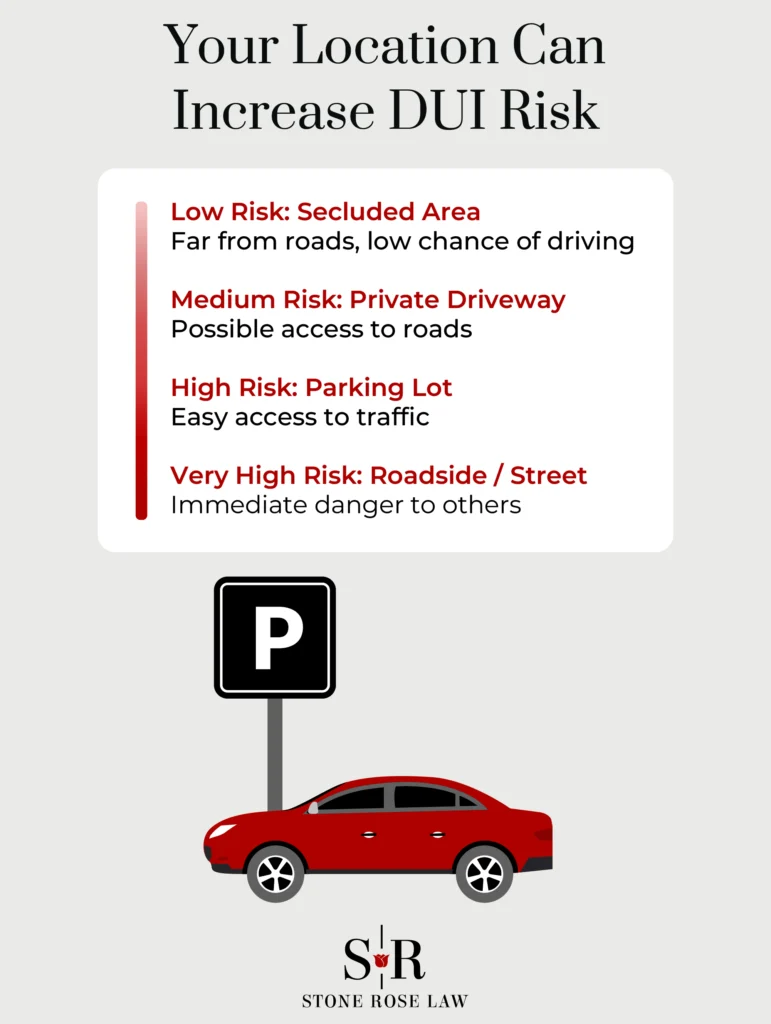
Some places can make it arguably less likely that you pose a risk of re-entering traffic while impaired. For example, the further away from traffic you park, like in a secluded area far from roads, or possibly if you are “sleeping it off” in the back seat of your car in your own driveway, these circumstances can suggest that you did not intend to resume driving but were rather using your car as a form of temporary shelter.
The legal consequences of a DUI conviction on private property in Arizona are the same as they would be if you were arrested on a public road. Arizona’s DUI laws do not treat a DUI on private property any differently when it comes to sentencing. A first-time DUI is a Class 1 misdemeanor—the most serious misdemeanor classification in Arizona—and it carries severe penalties even for a first offense.
A first-offense DUI conviction comes with a minimum of ten consecutive days in jail, though the court can suspend nine of those days if you complete alcohol or drug screening and any required treatment program. Fines and fees typically exceed $1,500 when you add the base fine to mandatory surcharges.
You also face a minimum 90-day driver’s license suspension and a court order to install an ignition interlock device on your vehicle for at least one year. A DUI conviction results in a permanent criminal record, which can affect employment, professional licensing, and insurance rates for years.
A DUI investigation does not always begin with a traffic stop. An officer can approach you on private property if there is probable cause to believe you are intoxicated — for example, a neighbor’s report, or the officer personally witnessing you driving drunk before you pulled onto private property. The officer can administer field sobriety tests and request a breath or blood test to determine your blood alcohol content.
If your blood alcohol concentration results show a level of 0.08 or higher within two hours of driving or being in actual physical control of a vehicle, the law creates a presumption that you were intoxicated. The amount of alcohol consumed, the type of intoxicating liquor or drugs involved, and the observations of a qualified medical practitioner can all be used as evidence.
It is also important to understand that Arizona’s DUI laws apply to more than just cars and trucks. You can face DUI charges on private property while operating a golf cart, an ATV, or any other motor vehicle. You can be charged with DUI if you are impaired to the slightest degree by alcohol, drugs, or any combination thereof.
Even if no one witnessed you driving, being found intoxicated in the driver’s seat with the keys accessible can be enough for an officer to arrest you for DUI on private property in Arizona. If you are facing DUI charges in Phoenix or anywhere else in Arizona, a DUI attorney can build a strong defense regardless of where the arrest happened.
The purpose of this blog post is solely to consider the question of whether, when a police officer is making the decision whether to arrest you for DUI in Arizona, it makes no difference if you are on public property or private land, including your own property.
The general answer is that the public or private ownership of property is not a deciding factor on whether to charge you with DUI. You can be stopped for DUI after you pull into your own driveway if, before then, a police officer has reasonable suspicion that you were impaired, giving the officer grounds to investigate and, if probable cause develops, to arrest you.
If you have been charged with DUI on private property in Arizona, important legal issues will be whether you were operating a motor vehicle while impaired by alcohol or drugs, whether your blood alcohol concentration supports a finding of intoxication, or, if the vehicle was not in motion, whether you were in actual physical control of it. Rosenstein Law Group DUI attorneys can defend you after a DUI arrest regardless of where it happened.
To speak with an experienced Arizona DUI defense attorney, call our law office at (480) 248-7666 at any time, day or night. Or you can use our online contact form to reach us and schedule a free consultation.