
available 24/7
Free Consultation
Whether you can be charged with driving under the influence (DUI) of alcohol or drugs in Arizona depends in large part on some key definitions provided under Arizona law.
Of particular importance is how the law defines what is, and is not, a “vehicle” for DUI purposes.
Electric scooters are one form of transportation that can lead to some confusion about whether you can be arrested for DUI while riding one.
In this blog post, our DUI attorneys at Rosenstein Law Group consider how Arizona’s DUI laws apply to vehicles and whether an electric scooter qualifies as a vehicle under Arizona law.
If you have been charged with DUI on a scooter, call our law office at (480) 248-7666 or contact us online to speak with one of our experienced DUI attorneys in a free consultation.
The late football coach Vince Lombardi often began coaching sessions by saying, “Gentlemen, this is a football.” In DUI terms, the equivalent expression is, “Ladies and gentlemen, this is a ‘vehicle.'”
It is important to understand, at the very beginning and at a fundamental level, which modes of transport Arizona police and prosecutors are likely to consider “vehicles” under Arizona law.
Arizona Revised Statutes (ARS) 28-1381(A) begins this way:
“A. It is unlawful for a person to drive or be in actual physical control of a vehicle in this state under any of the following circumstances…”
So we can see immediately that it is essential to understand what a “vehicle” is under Arizona law, because the law’s meaning is implicit: if you are not driving or in actual physical control of a vehicle, then the DUI statute does not apply to you.
Fortunately, Arizona law expressly defines what a “vehicle” is, so we do not have to guess. ARS 28-101(89) provides the answer. We provide the relevant text excerpts below.
“Vehicle:
(a) Means a device in, on, or by which a person or property is or may be transported or drawn on a public highway.
(b) Does not include:
(i) Electric bicycles, electric miniature scooters, electric standup scooters,and devices moved by human power.” [emphasis added]
So, we can already see that under Arizona law, some electric scooters are not considered “vehicles,” and thus ARS 28-1381(A) does not apply to them.
But we are not done yet, because Arizona law has additional definitions of what constitutes an electric miniature scooter and an electric standup scooter. Continuing with ARS 28-101:
“29. ‘Electric miniature scooter’ means a device that:
(a) Weighs less than thirty pounds.
(b) Has two or three wheels.
(c) Has handlebars.
(d) Has a floorboard on which a person may stand while riding.
(e) Is powered by an electric motor or human power, or both.
(f) Has a maximum speed that does not exceed ten miles per hour, with or without human propulsion, on a paved level surface.”
And,
“31. “Electric standup scooter”:
(a) Means a device that:
(i) Weighs less than seventy-five pounds.
(ii) Has two or three wheels.
(iii) Has handlebars.
(iv) Has a floorboard on which a person may stand while riding.
(v) Is powered by an electric motor or human power, or both.
(vi) Has a maximum speed that does not exceed twenty miles per hour, with or without human propulsion, on a paved level surface.
(b) Does not include an electric miniature scooter.”
It may be possible for an electric scooter to be a “vehicle” under ARS 28-1381(A) if it falls outside the appropriate statutory definition for what qualifies as an electric scooter.
If one of these weighs 30 pounds or more, or can reach a speed of faster than 10 miles per hour on a flat surface, or otherwise fails to meet any criterion under ARS 28-101(29), then it is no longer an “electric miniature scooter.”
If one of these weighs 75 pounds or more, or can go faster than 20 miles per hour on a flat surface, or otherwise fails to meet any criterion under ARS 28-101(31)(a), then this is no longer an “electric standup scooter.”
What happens if an electric scooter that is sold as an electric miniature scooter does not fit into all the definitional requirements of ARS 28-101(29)?
Can it become an electric standup vehicle under ARS 28-101(31)? The answer here is, “No.”
This is because ARS 28-101(31)(b) states that an electric standup scooter “does not include an electric miniature scooter.”
This exclusion is based on the device’s legal classification under ARS 28-101(29), not on its marketing or sale.
For example, let’s say you bought a miniature electric scooter that actually weighs 40 pounds and has a top speed of 12 miles per hour.
Otherwise, it has the same definitional characteristics as miniature and standup electric scooters: two or three wheels, handlebars, a floorboard, and the option to be human- or electric-powered.
Legally speaking, your scooter is too heavy and too fast to qualify as a miniature electric scooter.
Does this mean that you can still call it an electric standup scooter under ARS 28-101(31)(a), because it still weighs less than 75 pounds and has a top speed of less than 20 miles per hour?
This is a gray area. The 31(b) exclusion prevents a device that legally qualifies as an electric miniature scooter from also being classified as an electric standup scooter.
But if your scooter fails to meet the paragraph 29 definition—as in this example, where it is too heavy and/or too fast—then it is arguably not legally an “electric miniature scooter” at all, regardless of how it was sold.
Whether the 31(b) exclusion still applies to a device that was designed as a miniature scooter but does not meet the statutory criteria is an open question for a court to resolve.
In practice, a scooter in this situation may be classified as a ‘vehicle’ under Arizona DUI laws.
If your electric scooter does not qualify as an electric miniature scooter or an electric standup scooter because it fails to meet any of the definitional requirements of ARS 28-101(29) or ARS 28-101(31)(a), respectively, then the next question we must consider is, “What does it become instead?”
In this case, an electric scooter may be considered a “motor-driven cycle” under Arizona law, or even a motorcycle.
Before we discuss what a “motor-driven cycle” is under Arizona law, we first need to understand what a motorcycle is and what a motor vehicle is.
This is because a motor-driven cycle is what would otherwise be legally a motorcycle, but for an exception based on its motor’s power.
ARS 28-101(49) provides Arizona’s definition of what a motorcycle is:
“49. ‘Motorcycle’ means a motor vehicle that has a seat or saddle for the use of the rider and that is designed to travel on not more than three wheels in contact with the ground but excludes a tractor, an electric bicycle, an electric miniature scooter, an electric standup scooter, and a moped.”
Note that Arizona law has a broad definition for what can be a motorcycle. There is no legal requirement for its engine displacement, horsepower, or fuel type (electric or gasoline).
As we will see, this can become important when what you thought was an electric scooter morphs into something else entirely.
Under ARS 28-101(52)(a)(i), a motor vehicle is a “self-propelled vehicle” – as long as it does not otherwise qualify as an electric miniature scooter or an electric standup scooter.
So, when you are operating an electric scooter of any kind solely by its electric motor, it becomes a motor vehicle.
A motor-driven cycle is a variation of a motorcycle, but it is not a motorcycle because of horsepower limits on its engine.
ARS 28-101(50) defines what a motor-driven cycle is:
“50. “Motor-driven cycle” means a motorcycle, including every motor scooter, with a motor that produces not more than five horsepower, but does not include an electric bicycle, an electric miniature scooter, or an electric standup scooter.
What this means is that if you have an electric scooter that qualifies as a motorcycle – including a motor-driven cycle, which is a variation of a motorcycle – you need a motorcycle license or endorsement to legally ride it, and you need vehicle liability insurance for it, too.
How Does Electric Motor Output Translate into Horsepower?
For electric motors, in general, 1 horsepower equals 746 watts of electric output.
The table below shows how electric motor wattage converts into horsepower equivalents.
| Motor Power (Watts) | Approximate Horsepower |
|---|---|
| 250 W | 0.34 hp |
| 500 W | 0.67 hp |
| 750 W | 1.0 hp |
| 1,000 W | 1.34 hp |
| 3,000 W | 4.0 hp |
| 3,730 W | 5.0 hp |
| 4,000 W | 5.36 hp |
| 5,000 W | 6.7 hp |
Generally, Arizona law treats motor-driven cycles and motorcycles much the same as motor vehicles.
| Issue | Motor‑Driven Cycle | Motorcycle |
|---|---|---|
| Legal status | Subclass of motorcycle | Default category |
| Power limit | ≤ 5 hp | No limit |
| License required | Motorcycle endorsement | Motorcycle endorsement |
| Registration | Required | Required |
| Insurance | Required | Required |
| Equipment rules | Slightly relaxed | Full motorcycle rules |
For Arizona DUI purposes, both a motorcycle and a motor-driven cycle are considered motor vehicles.
If your electric scooter does not meet the legal definition of an electric miniature scooter or an electric standup scooter, then, depending on factors like your motor’s wattage and whether your electric scooter is equipped with a floorboard or a seat, you will likely be operating a motor vehicle that is legally a motor-driven cycle or a motorcycle.
Under ARS 28-101(49), a motorcycle is a motor vehicle with no more than three wheels that has a seat or a saddle for the rider.
As we have seen under the definition above under ARS 28-101(50), a motor-driven cycle is a motorcycle that includes a motor scooter, provided that the motor scooter does not qualify as an electric miniature scooter or an electric standup scooter.
So, the answer here is “Yes, your electric motor scooter can become a motorcycle” if it meets the following qualifications.
If an electric miniature scooter exceeds any of the criteria in ARS 28-101(29) — for instance, if it weighs 30 pounds or more, or can go faster than 10 miles per hour on the level — this removes it from the definition of electric miniature scooter.
If it also has a motor producing no more than 5 horsepower, it becomes a motor-driven cycle.
A motor-driven cycle is a sub-species of motorcycle characterized by a lack of a rider’s seat and a motor generating less than 5 horsepower. In effect, it is an exception to what would otherwise be a motorcycle.
An electric miniature scooter falls outside the ARS 28-101(29) definition if it fails to meet any single criterion, not all of them at once. For example, if it:
— then it no longer qualifies as an electric miniature scooter. If it also has a motor generating at least five horsepower and a seat, it moves past the motor-driven cycle exception and effectively becomes a motorcycle.
Similarly, an electric standup scooter falls outside the ARS 28-101(31)(a) definition if it fails any single criterion. For example, if it:
— then it no longer qualifies as an electric standup scooter. As with miniature scooters, if it also has five or more horsepower and a seat, it becomes a motorcycle rather than a motor-driven cycle.
As you can see from the above, whether you can get a DUI charge from riding an electric scooter depends on a number of definitions, distinctions, and exceptions under Arizona law. But here are some general rules you can take away:
Note that even if you are riding an electric scooter that does not end up becoming a motor-driven cycle or a motorcycle, you can still get into trouble if you are riding it while intoxicated by alcohol or drugs.
Police can charge you with other offenses aside from DUI penalties, including but not limited to endangerment.
As you may imagine, it is often not easy for a police officer to know, from observation alone, whether your electric motorized scooter falls outside the exact legal definition of an electric miniature scooter or an electric standup scooter.
Often, when a police officer stops a rider on an electric scooter, the reason will be based on observing rider behaviors that give rise to what the officer believes is reasonable suspicion of intoxication, like:
Also, other possible defenses that may be available for DUI or traffic stops if you were driving a car may apply when you are riding an electric scooter.
For example, you may not be intoxicated based on your blood alcohol concentration (BAC) level, or if the officer subjects you to field sobriety tests, he or she may not conduct them properly, or the officer may not properly observe your civil rights while you are in detention or after arresting you.
Or, if the officer’s reason for arresting you was based on actual physical control, then you may have defenses to cast reasonable doubt on whether you were indeed in such control at the time of your arrest.
Our purpose in this blog post is not to discuss Arizona DUI laws generally, but rather to examine the specific question of whether a police officer can charge you with an electric scooter DUI.
If you have been charged, we encourage you to call Rosenstein Law Group to discuss the facts of your case with one of our experienced DUI attorneys.
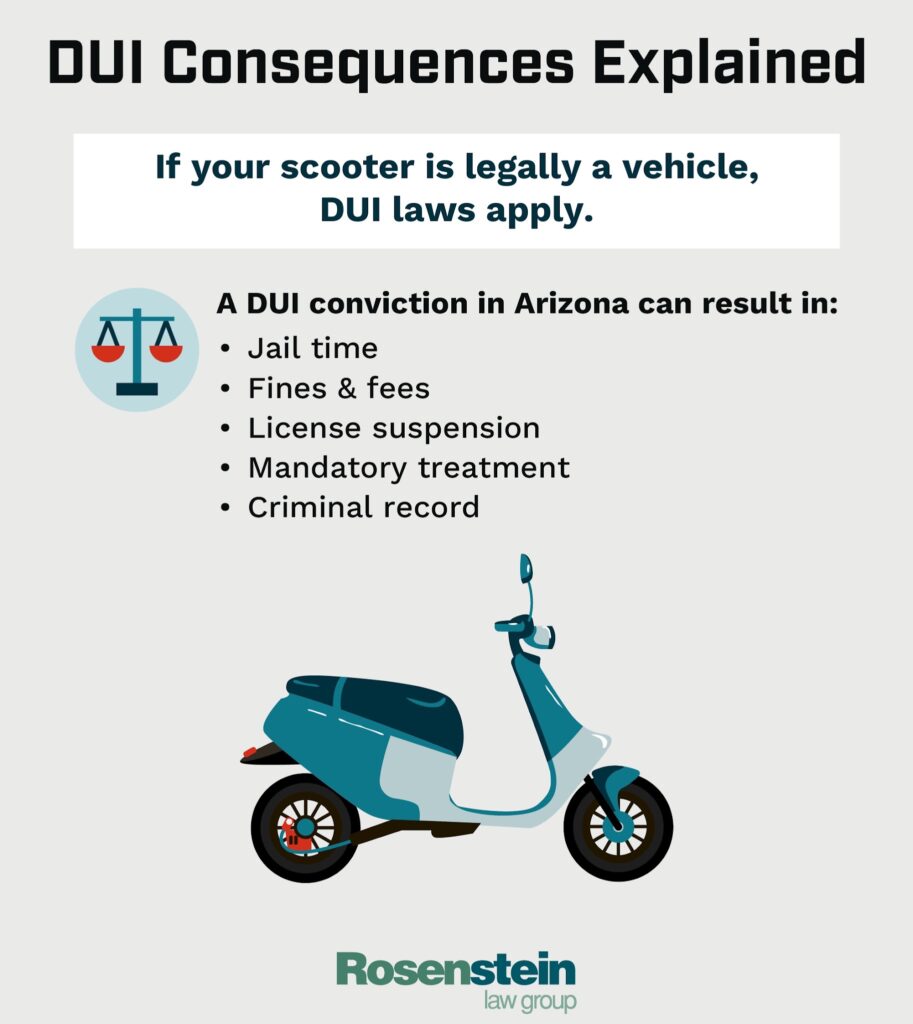
No matter what kind of means of transportation you may be using at the time of a DUI arrest, if you are convicted of DUI in Arizona, you could face serious Class 1 misdemeanor legal consequences, including:
In addition, having an e-scooter DUI conviction on your criminal record can have lasting consequences, though Arizona law under ARS 13-911 may allow eligible individuals to petition to have their records sealed after a waiting period.
At Rosenstein Law Group, our DUI attorneys have many years of combined experience providing legal representation to Arizona residents facing state and local criminal charges for driving under the influence, including cases involving electric scooters, electric bikes, electric skateboards, and non-motorized scooters.
We can help you to understand the drunk driving charges against you, investigate the facts that led to your DUI arrest, and prepare a strong defense in plea negotiations or at trial.
To speak with a skilled Arizona DUI defense lawyer, call us at (480) 248-7666 or use our online contact form to set up a free initial consultation with one of our legal professionals.